

Why do you read what you read? Have you ever identified your reading obsessions, the ideas or themes in books you may find yourself irresistibly drawn to? I had not, at least not in a way that felt systematic and satisfying enough, until I read a piece called “My reading kinks”, in which Petya K. Grady asked herself and her readers:
What are the themes, tropes, details, and settings that excite [you] every time?
Which books have you devoured with a surprising level of intensity?
What makes your brain light up?
It was time to test my own bookshelf and finally put my favorite reading obsessions into words.
💮
Intense interior emotionality, and how others deal with life troubles
I currently read more non-fiction than fiction, but when I manage to find the kind I want to devour, it often dissects relationships or family ties that are stretched thin by contradictory human emotions. Desire and disappointment, intimacy and independence, joy pitched against grief. When I looked for some of my favorite fiction novels on my bookshelf, I was struck by how often they share some varying degree of this haunting question: how do their characters balance true closeness with the need for space?
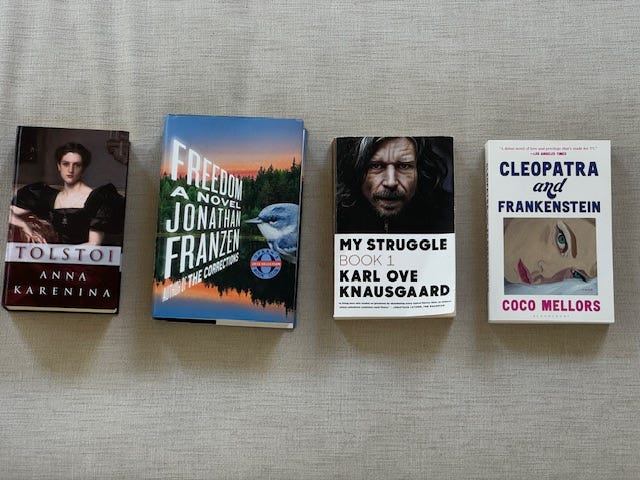
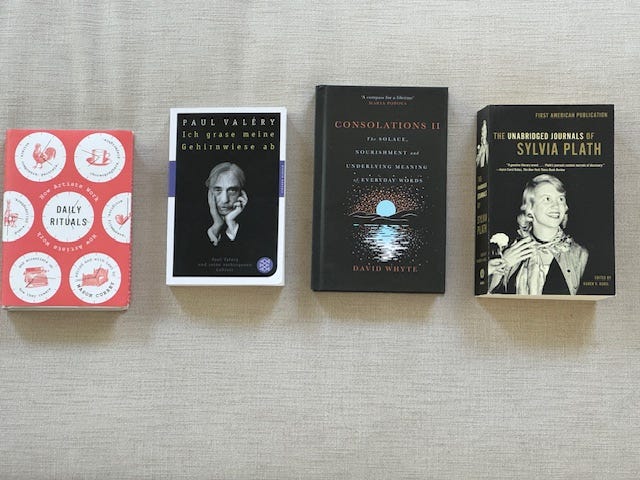
Writers and artists and their truth-in-the-making
Peeking into writers’ or artists’ lives is endlessly fascinating to me. What raw thoughts, feelings, or rituals keep them returning to page or canvas, again and again? The following books are the kind of distillations I love and often return to. Hidden in a journal note, personal essay, or the description of a daily devotion, I might find what I didn’t even know I was looking for. In their human struggle and need for rituals, I sometimes catch an echo of my own search for aliveness and creative inspiration.
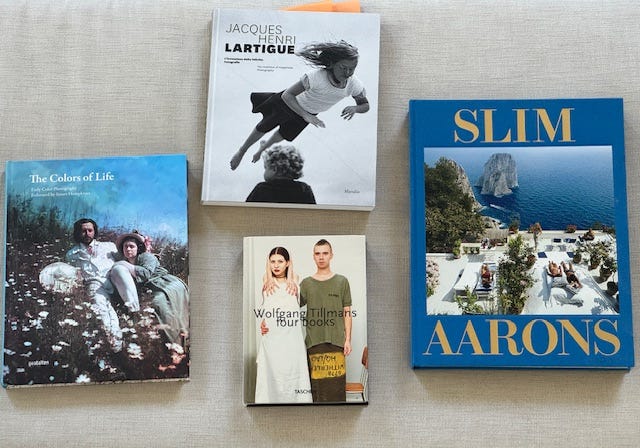
The life energy I find in photography books
I collect more photo books than art books and started wondering why. Maybe it’s because the photography I favor – people, always people! – tries to capture the mystery of life and time, and the beauty of impermanence. Photography is a form of attention: to notice, (re)discover, and celebrate the vigor of life right when it happens and before it slips away again.
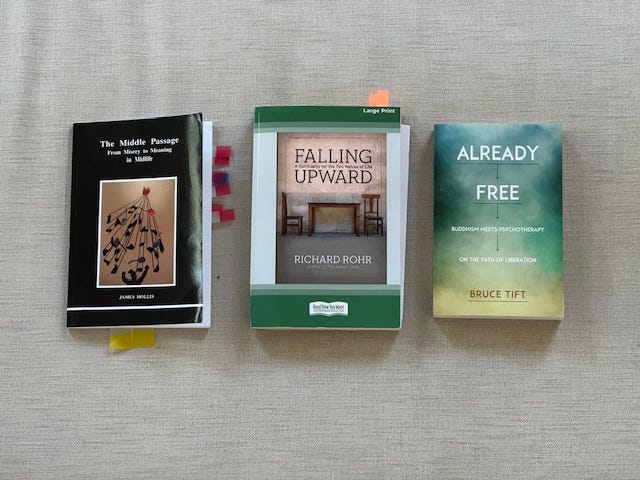
The ego’s tug-of-war with wholeness
I feel drawn to books that capture the ongoing dialogue between the ego and one’s deeper self. The small self craves control and security, whereas the larger self insists on wholeness and authenticity. These books explore the inner tensions during life transitions, such as the reckoning and spiritual reorientation that often happens in the second half of life (James Hollis or Richard Rohr), or how to understand the differences between Western psychotherapy and Eastern Buddhism (Bruce Tift). Each in their own way, they have helped me wrestle with my own contradictions and to see them not as failures but as areas of growth and possibility.
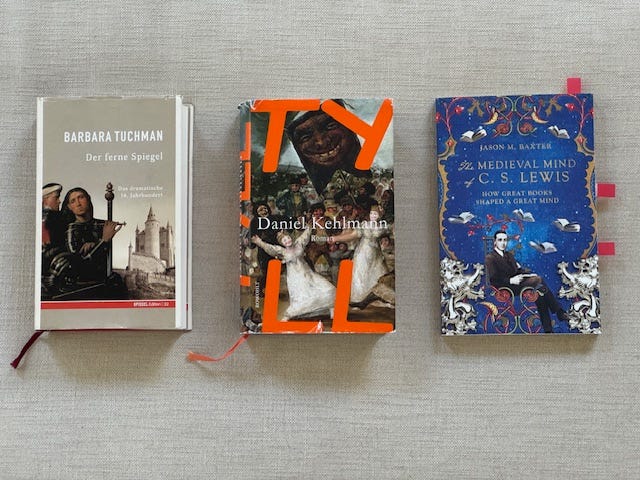
What’s it with my fascination over the medieval mind?
I remember feeling the first “pull of the medieval mind” when I watched The Name of the Rose when I was twelve. What a mystery: how and what did people think and feel who lived a few hundred years before me? The wrestling with meaning, chaos, order, and the unknown, still faintly resonating despite the gap of several centuries, appears alien and yet not all different from my own.
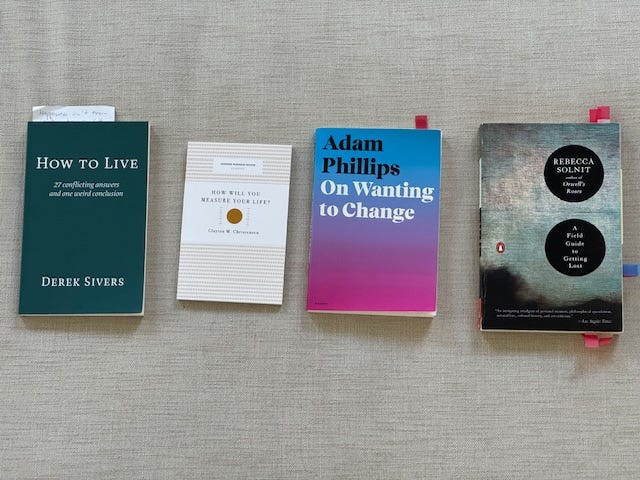
What does it mean to live a meaningful life?
For me, part of the appeal of books around this fundamental question is that the answers rarely agree. Derek Sivers offers a thought experiment of 27 competing answers, Clayton Christensen frames life as a moral reckoning, Adam Phillips writes about the restless human desire to change (so fascinating!), while Rebecca Solnit explores how we may only find ourselves after getting lost first. I cannot thank these four authors enough – as well as the countless other writers (yes, you too) – whose voices have helped me in adding perspective and depth to what feels true and purposeful in my own becoming.
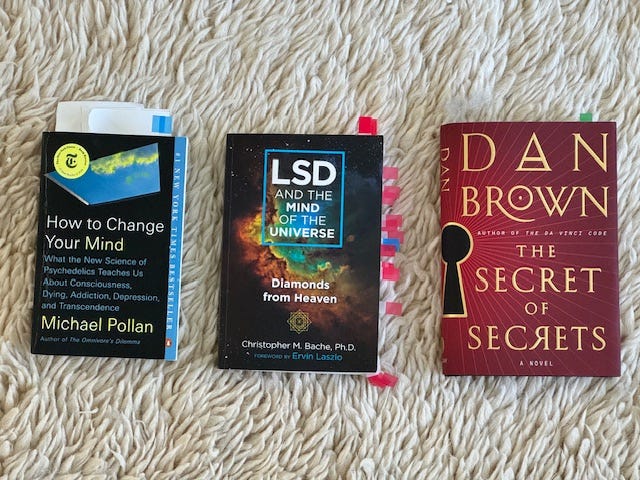
Consciousness and altered, non-ordinary states of mind
What is consciousness, and how can we begin to glimpse its depth and countless states and dimensions? These questions feel as fresh as ever, (re)surfacing now with new urgency. The books I return to suggest that these explorations are not fringe curiosities, but a fundamental frontier that may ripple outward into cultural and even evolutionary change. The stakes are high, and at their core, they ask whether the mystery of consciousness might hold not only the critical key to our capacity to flourish, but also for humanity to come together and survive.
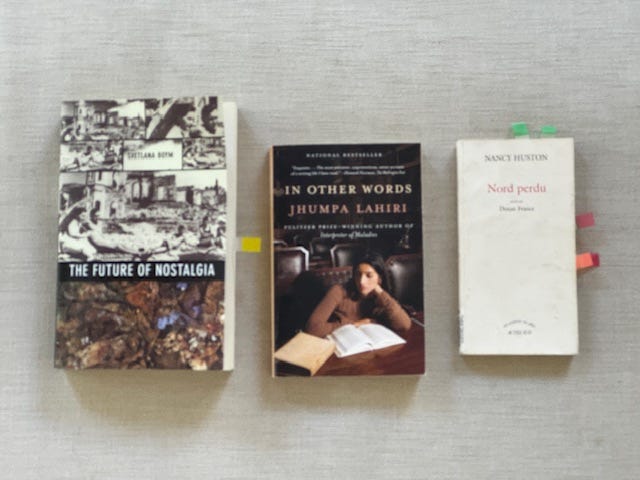
The paradox of the immigrant and multilingual condition
The role of identity, in particular around the immigrant experience and all its contradictions, is another thread I like to follow: the ache of homesickness and nostalgia, the strangeness and enchantment of second languages, and the way one’s identity gets remixed by the tensions between different languages and different worlds. Svetlana Boym has written a whole compendium about nostalgia, Jhumpa Lahiri immerses the reader in two languages at the same time, while Nancy Huston excellently captures the delicate estrangements that happen after one leaves home and country. Books like these have reminded me that building a new life far away from home is never just about loss, but also about the incredible enrichment that comes with living a life of one’s own.
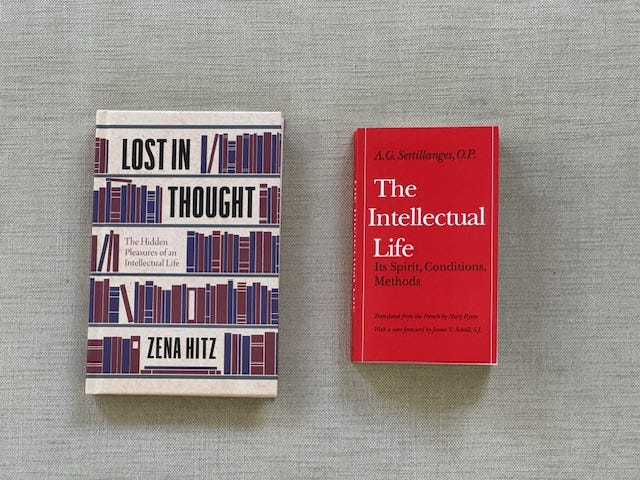
The intellectual and bookish life
Growing up, I sometimes felt embarrassed by how much joy I took from libraries and bookstores, even dreaming that one day I might have a bookstore of my own. That never happened – and that’s totally okay, considering I now have shelves full of books that I love. What has remained is my pleasure in the utter absorption and interior life of books, full of their own demands. Zena Hitz captures this so beautifully in her celebration of study for its own sake, and how intellectual inquiry must be enjoyed to be worth the cost. A hundred years earlier, Sertillanges had laid out a demanding (and inspiring) vision of study as a vocation. I’m grateful to have the opportunity to live a somewhat bookish life now; it feels like my own adventure and back to the roots.
….and lastly
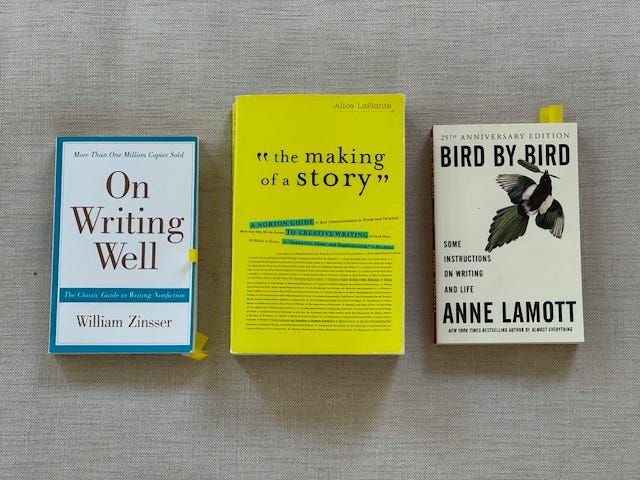
What would a list of my reading obsessions be without books on writing? There are three dog-eared companions I come back to the most. First, Anne Lamott, of course. This quote may have been more powerful than anything else that got me first into writing: “You are going to feel like hell if you never write the stuff that is tugging on the sleeves in your heart…your truth, your version of things, in your voice.” Wolfgang Zinsser continues to encourage me to trust my material more, while Alice LaPlante, who likes to get into the bones of narrative, offers some great parting wisdom with this:
“We are afraid that events that call forth [our intense] emotional experiences may seem inauthentic, or overwrought. We do not think we have the right to claim these emotions. Yet we do. And what’s more, our ability to write truly moving fiction and creative nonfiction ultimately derives from our ability to transform these very deep and very true experiences into language that effectively arouses deep, true emotions in others.” – Alice LaPlante
This concludes my list, and I can’t wait to see how it will morph over the next few years of reading. And I would love to hear from you: what are books and questions YOU are currently obsessed with?
Acknowledgments
I thank Rachel Parker, Chao Lam, Rick Lewis, and Linda Kaun for reading and commenting on drafts of this piece!
I love the photos of the books. Makes me want to revisit my own book shelves. I especially loved your observation that "Photography is a form of attention: to notice, (re)discover, and celebrate the vigor of life right when it happens and before it slips away again." It strikes me that this also applies to our writing, the capacity "to notice, (re)discover, and celebrate the vigor of life . . ." is the foundation of our skill as a writer, and, it applies once again to our reading, and our viewing and perception of life—because when an artist, whether it's a photographer or a writer—shows us what is hidden in the everyday life we often pass by, they are training us to be able to catch and appreciate life's beauty, and mystery, and value as it happens. Artists teach us where and how to look before the best of life passes us by.
Brigitte, I'm impressed with the wide variety of books you read (and occasionally devour; I know the feeling), as well as the thoughtful manner in which you break them down by category.
On a personal note, I read "How to Change Your Mind" twice, and it spurred me into a six-hour doctor-supervised psilocybin journey that blew me away. (That may be an essay in the future -- still not sure.
Again, very well done!