

Welcome, and I’m so glad you’re here. This piece is a bit different from my recent more introspective essays. I was inspired to reflect on some ideas from two books that we picked for the book club of ‘The Leading Edge,’ a collaborative and (in-)spirited community of thinkers, practitioners and investors led by Tom Morgan.

It’s beautiful when ideas from different disciplines meet and, instead of clashing, can enhance and deepen our understanding about them. I had this experience again recently when I was reading these two books in tandem: The Matter With Things—Our Brains, Our Delusions and the Unmaking of the World by Iain McGilchrist and David Whyte’s Consolations—The Solace, Nourishment and Underlying Meaning of Everyday Words.
Our lives are largely determined by how we think and feel, and both books deliver precious perspectives and visions of how we can do exactly this: grapple with the how and why of these fundamental questions of human existence. The rigor of neuroscience meets with the soulful introspection of poetic expression, creating a
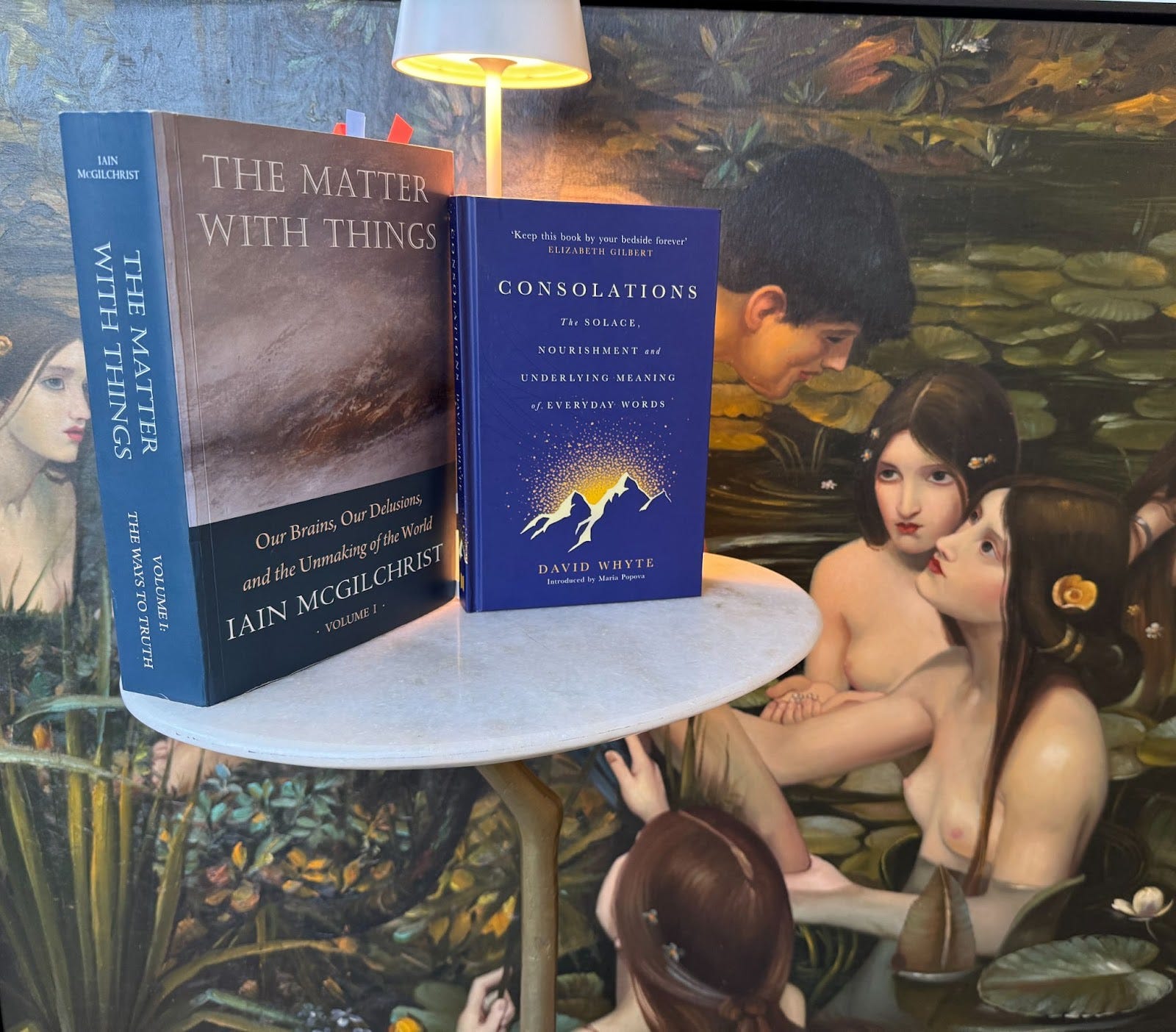
dialogue that illuminates both disciplines in profound ways. It is striking how McGilchrist’s framing of metaphor and poetry as some of the means by which we come to know the world resonates so deeply here. They act as a bridge, connecting the more rigorous neuroscience with the reflective, interpretative lens of poetry—expanding our grasp of the complexities of being thinking and feelings humans.
In The Matter With Things, Scottish neuroscientist Dr. McGilchrist analyses and applies his sweeping scientific and philosophical hemispheric theory to the world and reality, and our place in it. On the most fundamental level, his vision is based on the profound observation that the two hemispheres of our brain see the world in fundamentally different ways. The left hemisphere, analytic and detail-oriented, seeks clarity and control, breaking down the whole into its constituent parts. The right hemisphere, in contrast, is relational and expansive, attuned to context, ambiguity, and the interconnectedness of life.
McGilchrist argues that our understanding of the world and ourselves is at its richest when these two perspectives are in balance. However, in modern life, the left hemisphere’s narrow focus often dominates, at the expense of the right’s more intuitive, holistic, and embodied wisdom. This interplay between the analytical and the relational offers access to meaning—which we all crave and need so much—and reminding us that wisdom emerges from the integration of two complementary ways of seeing (see more on this aspect of ‘seeing’ under the vignette ‘beauty’ below).
A quick spoiler alert: For a lot of what actually matters, it is the right hemisphere over the left hemisphere that has—or rather should have—”the final say.” The following excerpts and quotes from the sources will reflect further on this view.1
In Consolations, poet and philosopher David Whyte takes readers on an exploration of both beauty and struggle inherent of the human experience in a different way: He uses everyday familiar terms, such as courage, loneliness, beauty, pain, etc. and describes them with poetic precision and profound insight in the form of short and meditative essays.
So let us begin a short journey and exploration across a few select themes from Whyte’s essays and how they converge, touch, or overlap with an integrative philosophy of neuroscience.
i. beauty
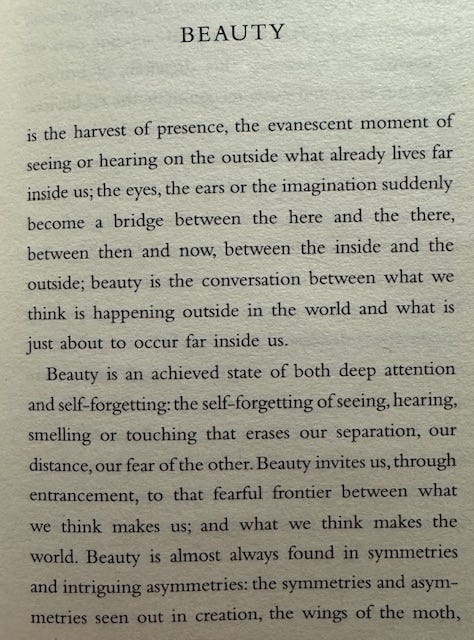
For Whyte, the eternal theme of beauty is not a distant ideal but an intimate, transformative presence that invites us into a deeper engagement with life. It emerges when we are fully present, “entranced” by the world’s imperfect nature against our fears. Beauty, for Whyte, represents a call to vulnerability and connection, a reminder for our shared humanity, and the realness and richness that comes from witnessing and being witnessed.
McGilchrist argues that beauty is universal—there is no formula for it, it can’t be commanded. It has to be experienced, and in that experience we become “aware of being the presence of something greater than ourselves.” This perspective resonates with Whyte’s idea of beauty as an invitation to deep relational engagement—necessitating vulnerability and humility.
Both McGilchrist and Whyte highlight beauty’s role in transcending the mundane. McGilchrist sees beauty as arising harmony and unity and is picked up by right hemispheric perception. He asserts that “beauty is a matter of seeing through the surface to the depth, seeing through the parts to see the whole [its Gestalt].” The way we see beauty is by seeing with “soft eyes”: a gaze that is wide, open, and receptive. And this receptiveness of aesthetics, again, is highly dependent on the right hemisphere. Writes McGilchrist,
“Aesthetic appreciation involves perception, emotion, intuition and cognition, (...) emotions of pleasure, disgust, sadness, joy, or awe; and draws on responses to form, colour, sound, action, memory, association with bodily sensations, sexual responses, action preparation, and much more.”2
Whyte locates beauty in the symmetries and asymmetries of life, in the tension between the opposites of imperfections and perfections, that ground us in shared rhythms of existence and the interconnectedness of the human and human-made world. McGilchrist similarily highlights the right hemisphere’s ability to find beauty both in symmetry and subtle variations and imperfections, as a testament to the right hemisphere’s sensitivity for balance and harmony.
ii. shadow
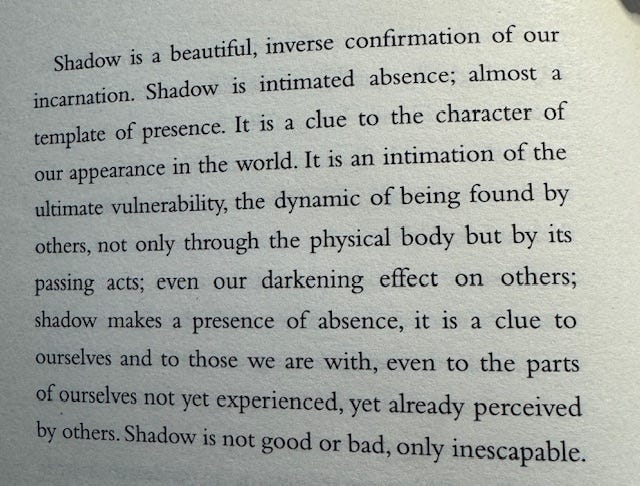
Whyte calls shadow a “presence of absence,” representing the unseen parts of ourselves that shape how we appear in the world. Shadow is inescapable, a reminder of our ultimate vulnerability and interconnection with others. It’s not good or, as we typically like to think, bad, but rather essential and human.
Within the framework of McGilchrist’s right hemispheric engagement with absence and relational depth, shadow can be seen not as a flaw but an integral part of understanding ourselves in relation to the world. In The Matter With Things, he refers to shadow as “what Jung called the dark side.” More specifically he writes, in this wonderful quote:
“Every adult human being must learn to accept the contradictions in himself or herself which we all inevitably embody; and learn even to embrace them. This acceptance and embrace is not just good for us in the sense that, while it does not change anything, it brings us to a position of reconciliation with ourselves: it does really effect a change. It helps us to draw the venom of what Jung called the dark side.”3
The left hemisphere might attempt to suppress or explain the shadow away, while the right is in the business of accepting: our contradictions, dark next to light, and lastly our striving for a union of union and divisions—we need both.
iii. courage
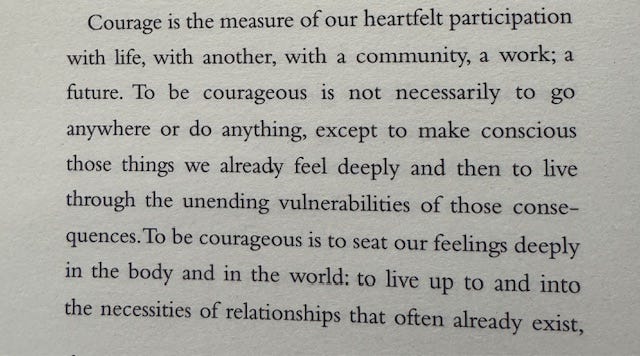
Similar to beauty, Whyte also roots courage in a heartfelt participation with life, an active engagement with relational depth and our vulnerabilities. He rejects the notion that courage is about dramatic action; instead, it’s about living with integrity and presence in the face of uncertainty. Courage, for Whyte, is deeply embodied and tied to the “necessity of relationships.” It requires anchoring ourselves in the present: within the body, within our communities, and allowing connection and care to guide us.
This perspective mirrors McGilchrist’s emphasis on the right hemisphere’s capacity to embrace paradox and the unknown. It reflects an openness to life’s uncertainties, encouraging us to intuitively engage with the present and the relational aspects of experience. For him, courage involves stepping away from the left hemisphere’s impulse for control and abstraction in favor of an embodied approach to life’s inherent ambiguities (examples: staying with even difficult conversations, engaging in art, music, or writing, or practicing to hold oppositional views/positions in our minds).
Together, both authors reveal that courage should not be considered a singular heroic act but a continual practice of presence and engagement that orients us to the interdependence of our inner and outer world.
iv. memory
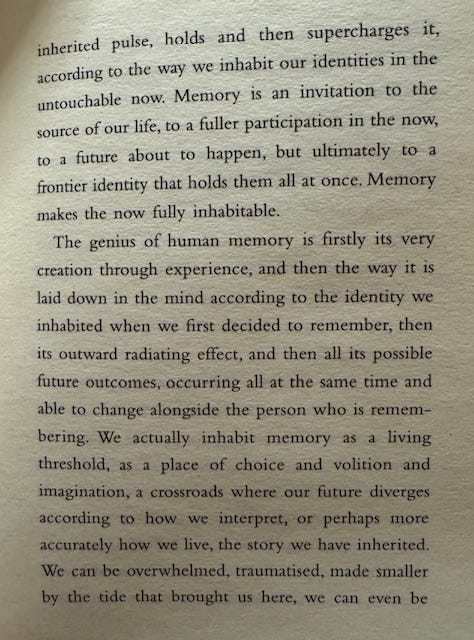
Wythe brilliantly describes memory as a “living threshold”—a crossroads where chance, choice, and imagination converge. It is deeply relational, shaped not only by what we remember but also by how we reinterpret those memories in the context of our lives and our believed identity and attitudes. Memory in that understanding ties the present to both past and future: if we participate fully in the present, we connect to the unfolding possibilities of the future—and this, I find, is such a transformative insight: Memory is both a psychological act (we can make peace with past negative beliefs and trauma) and a creative act. We can orchestrate our remembering, through the feelings in our heart. We are not locked in the past; memory has the potential to transform us and vice versa (I wrote about ‘The Art of Memory” in an earlier essay here).
McGilchrist complements this view by emphasizing the right hemisphere’s role in memory as an integrative and associative process. It excels at making connections, resisting reductionism, and holding autobiographical memory in a way that fosters a deeper relational understanding. He sees memory as alive and active, rooted in the emotional and narrative dimensions of life rather than mere recall of (auto)biographical facts.4
v. rest
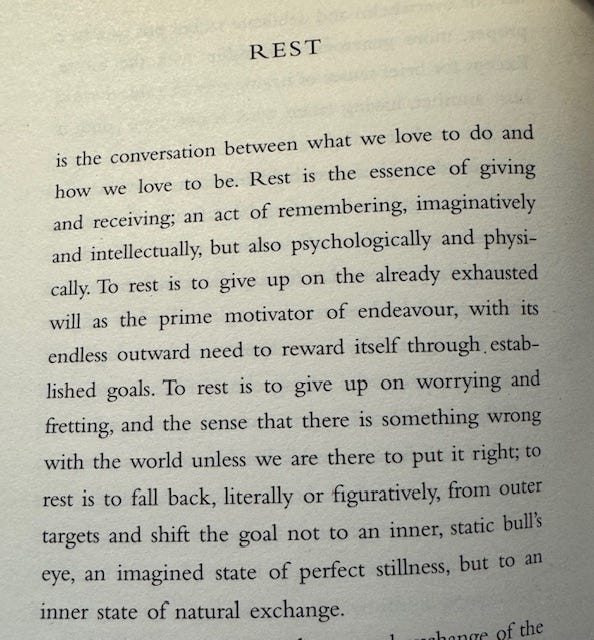
This essay’s last vignette is short but meaningful, and it is about rest.
In Consolations, Whyte reframes rest as an essential act of reconnecting with life’s rhythms. It’s not just the absence of activity but a deep, embodied experience of letting go and returning to ourselves. In this understanding, rest is not passive but an active reengagement with life and our surroundings. We are to feel what rest means, and make it part of our lived experience.
And the right hemisphere also shines here, once again. It allows for being—a mode of attention that values presence and receptivity over the left hemisphere’s constant doing. McGilchrist emphasizes this in multiple passages of his book, advocating for a patient, open way of understanding the world: through a patient, more lightly held—relaxed and rested— awareness of whatever exists apart from ourselves. That aligns seamlessly with Whyte’s call to make rest a lived experience, rooted in attention and care.
In the end, perhaps the most profound wisdom from reading these books and applying this (limited) scope here lies not in striving to constantly conquer life’s complexities and contractions but in learning to sit with them. The wisdom emerges in the spaces—those liminal moments between certainty and uncertainty, where courage meets vulnerability, where beauty reveals its depth and invites us to pause, and where memory and ambiguity shapes and reshapes our self-discovery. These are the spaces where we are most fully alive and life gains meaning. And how rest, in its subtle ways, teaches us to simply: be.
This leads us to consider how also our language, as McGilchrist argues, is deeply tied to lived experience, historical context, and—once again—to these in-between spaces where language moves beyond mere literal meaning to something more expansive. Here, Whyte’s poetic expression becomes essential: it invites us to experience what lays beyond the literal, into something felt, something intuitive, something that analysis along cannot grasp. In this way, poetry becomes not just a form of expression but a way of seeing the world, opening us to truths that cannot be pinned down by reason alone.
And in this sense, what we may want to take away from these beautiful books is the reminder that a more poetic, metaphorical lens serves as one of the bridges to something larger and more enduring. It teaches us that to live fully is not to solve life, but to dwell in its mysteries also. To see, feel, and participate in its endless unfolding.
While both brain’s hemispheres have important functions including lateral competition and cooperation, the central idea of McGilchrist’s work is that of an imbalance between the hemispheres: the left should be the servant of the right, but it is now too often the master. This can be problematic due to the left hemispheric narrow focus and reductionist limitations. The ideal formulation is a Right => Left => Right transition, with “real world experience to originate in the right hemisphere, to be moved to the left for processing, but then [and – critically –] returned to the right for synthesis into its global context … Problems emerge when we fail to do the essential final stage of putting the pieces back together.” (Tom Morgan, Insights from ‘The Matter With Things’ on Dr. Iain McGilchrist’s website)
The Matter with Things, p. 1156, 1157
The Matter with Things, p. 837
A bonus McGilchrist idea in his writings about memory that I found interesting: He also explores the phenomenon of magical thinking. He suggests that magical thinking, defined by him as the “belief in forms of causation that by common consent are invalid,” may not be delusional but instead reflect an adaptive creativity, enabling us to explore meaningful connexions, “some of which are no doubt non-existent, but some of which may simply not be recognized in the current Western standard model. [...] Some physicists are now prepared to accept a number of realities that are contrary to what used to be conventionally accepted, such as apparent action at a distance, the apparent influence of consciousness on the behavior of matter, and the possibility of holographic existence.” (The Matter with Things, p. 161)
This is beautiful, Brigitte! It came together so well and I really enjoyed the vignette style. You inspired me to learn more about McGilchrist too—so fascinating. Always love reading your work and the new curiosities it evokes in me. Bravo!
Thank you Brigitte for the introduction to these two works and the thinker/artists behind them. But equally, I feel that I am getting to know you better, the depth of your own thinking and the buoyancy of your spirit through this essay. I particularly love the quote about how acceptance and embrace of our shadow draws the venom of our dark side.