

1.
It was a quiet evening after Christmas, the red glow of a Swiss sunset in winter still brightening our spirits. My sister, her husband and I were sitting together with a glass of chilled Chablis, letting the conversation drift through anecdotes and memories. Beneath the light mood lay weight of life’s reality. Our visit wasn’t just a joyful holiday with family, but also an episode of witnessing the slow unfolding of our parents’ old age. The past felt quaint, and close, but time had undeniably moved forward.
Still, the mood was easy enough, with a low-stakes intimacy that mutes vulnerability. I had been keeping my writing to myself since taking it more seriously last year, almost hilariously hesitant to share my more personal thoughts with those closest to me. Those I rather reserved for a small audience of like-minded strangers on the internet. That night though, buoyed by the warmth of the moment, I found myself asking, “Do you guys want to hear something I wrote about our old childhood home?”
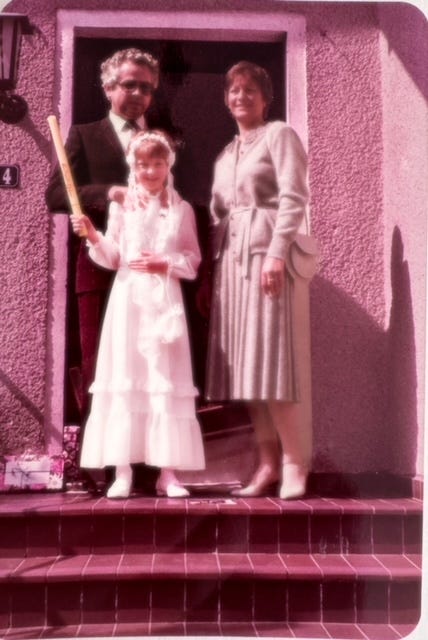
The essay I was pulling up on my phone was the first Substack piece I had ever published, as part of the Write of Passage class I had taken the preceding fall. In what I called The Art of Memory, I had labored to bring to life house in rural Germany where we had grown up, an homage to the place we had long left behind. The essay unfolded along the map I had so much studied with my childhood’s eyes. There were the red-tiled steps, the texture of the brown carpet, our father’s old armchair, and walking in and out of these rooms of the past, I felt touched by rising waves of familiar movement. Our sounds, our shadows.
Now, reading my words strangely sharpened the details, the house got dragged even further out of memory, right into the height of presence of this very moment and my older sister sitting right next to me. There this house stood again with so much clarity, as if breathing and kept alive by the pulse of personal meaning. And she was intently listening. Her gaze on me, steady and searching, I felt both seen and exposed. When I imagined entering our old kitchen, by paragraph four of the essay, my voice had started to crack. Once again I could see our once so chic olive-green cabinets from a 70s kitchen and the small kitchen table, where we so often sat to study, play and joke around. Upon recalling my mother’s younger voice and bright laughter, tears were running down my cheeks.
God did the essay strike differently in my sister’s presence. Flushed, and a bit flustered, I was finally done reading, and then looked up. At least half expecting to see my sister moved as well, she asked me with a caring but measured expression, her eyes still searching:
“Do you struggle with memories like that?”
2.
They rang the doorbell of our suburban Minneapolis home on a late weekday afternoon near the end of summer, about six years ago. Two friendly-looking women stood in front of me, one around my age, the other much older—frail, her frame bent with time. It took just a moment and a few words of introduction to recognize the older woman: Mrs. Greengard. Together, she and her husband had built the house in the mid-80s, a modernist-influenced home with a contemporary style, the one I was standing in and had bought from them over 15 years ago. The house I fell in love with at first sight and went on to turn into my American Home. How young I had been, joyfully renovating, eager to brush fresh color and future on its walls. I hadn’t thought much about how I was also painting over the Greengards’ family stories held within.
My daughter and her friend’s laughter, running down the upstairs hallway during a playdate, were traveling down to us. Life was moving forward, filling the house with youth and fresh sounds. The younger of the two women—Mrs. Greengard’s daughter—now asked on behalf of her mother, their arms touching:
“Do you think it would be possible for my mom to see the house again?”
3.
My sister’s reaction startled me. An old, familiar heat—embarrassment—flushed across my cheeks and chest. I reeled. Oh why these tears, why now? Then, beneath them, something sensitive and quieter, the ache of holding a memory that no longer seemed to belong to both of us. The tears felt heavy, lonely without hers.
My writing had been an act of translation, turning raw memory into something tangible and spoken in my own voice. Was that what I was hoping for? To connect, for her to see what I saw and feel what I felt?
But for my sister, the house, at least in her current emotional state, may just have been a house, its rooms silent, not holding the same nostalgia that was now stirring in my chest. Maybe I had wished she would have stepped into the memory with me. But memory is also this: leaving each of us holding different pieces. Perhaps her own memory held little for her or at least not the same as for me. Or, perhaps, more than she was ready to touch.
Memory doesn’t always bind us together the way we expect, even when we inhabit some of the same moments, like my sister and I had done in this childhood home. What lingers and carries weight feels different for to two of us. Memories are deeply personal and don’t retain the same emotional coloration, are even physically differently encoded in the circuitry of our minds.
Memory is both personal and relational, tethering us to people and to places and other versions of ourselves, even ones we thought we already shed. People close to us who move – or once moved – with us through our days, add more context and deeper layers of memory based on what we know about each other. Making them more real, somehow thicker in detail and texture.1 I once read that we may even carry people as our “imaginary witnesses,” how they become our silent observers we conjure to help validating our experiences.
So when I was thinking about our childhood home with such emotional vigor, had I turned my family, and with it my sister, into this role of imaginary witnessing? In this way, sharing my essay was an expression of my unconscious hope that her presence would make memories even more vibrant and full color again, for me and for her. From sister to sister. That her eyes on them proved even more how much they mattered, even in 2025.
But can memories ever belong to anyone but the one who holds them?
4.
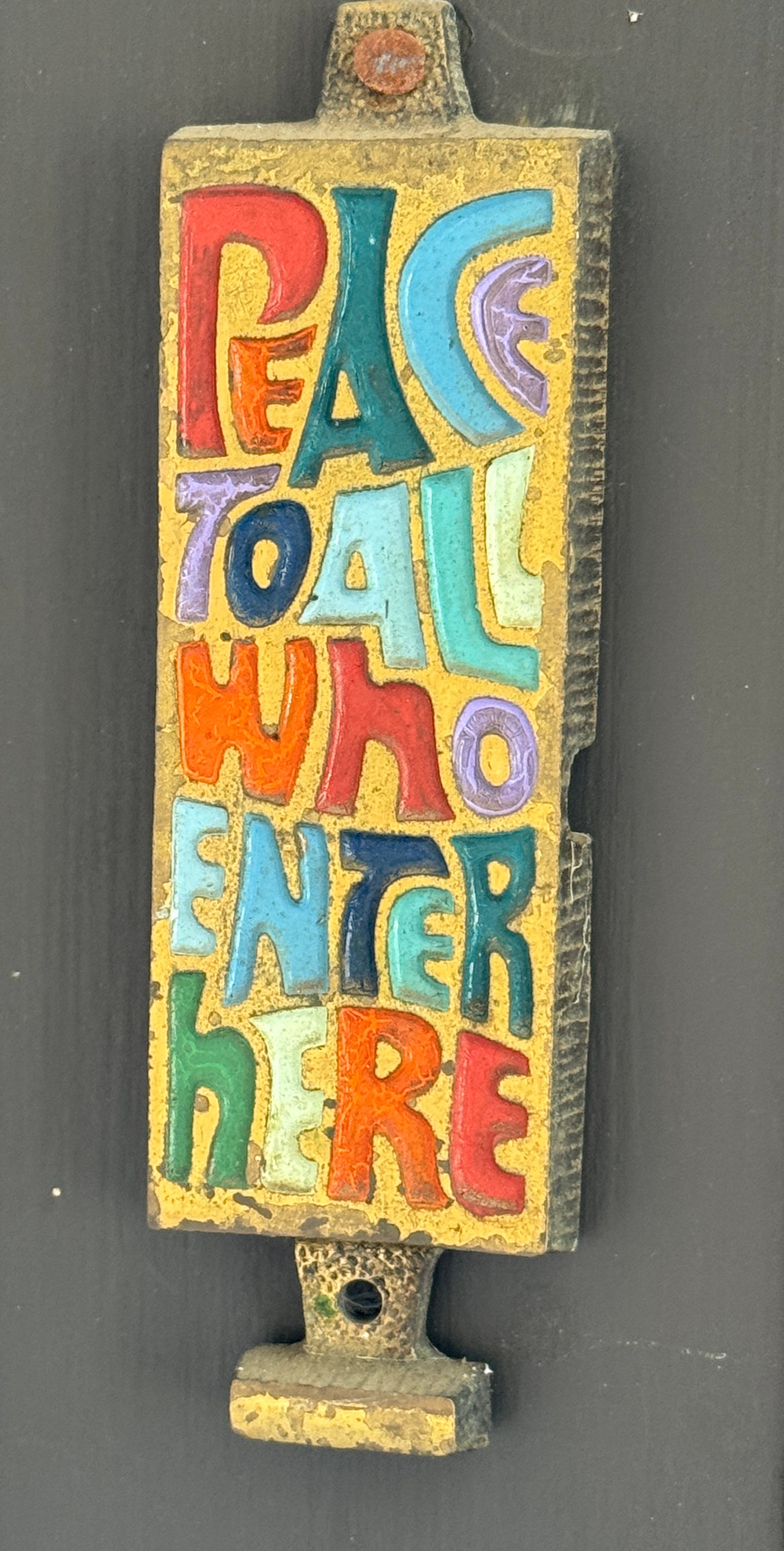
I welcomed both ladies in. As Mrs. Greengard stepped in, her eyes flickered for just a moment – or did I just imagine this? – toward a particular spot on the door frame. As if searching for proof that time had been holding space, had left something from theh past untouched, right in this spot. And there it was: the weathered plaque that said Peace to All Who Enter Here. We had intentionally left it right there on the door’s frame after moving in, exactly where the Greengards had put it, likely close to 40 years before.
I said, “Please take as much time as you’d like. The house might be a bit messy…my daughter is having a playdate with a friend. Oh, and, I—I’ve made quite a few changes to the house over the years, I hope you can still recognize it…”
They moved past me with soft steps. I remember how I wondered where Mr. Greengard was. Both women seemed content to be here, present in this moment. Who knows how many times they had driven past, talked about stopping but never had. I stayed behind, trying to busy myself with arranging one of my many stacks of books. Granting the two the privacy I felt they wanted.
I’ll never know what room or hallway they stepped into that day. Did they pause in the kitchen where they used to brew their coffee in the morning, or by the nook where the daughter might have sat to do her homework? Did she brush her hand against a doorframe, the place where they had measured their kids’ heights, or look for her husband reading the paper in the living room, sunlight one more time reflecting dancing leaves from lush trees in the green backyard? Especially now, as I write these lines, I hope they found at least a trace of what they were looking for that day. Something to hold on to for the journey still ahead.
Back at the doorway after just a few minutes, they lingered. Mrs. Greengard’s gaze swept the room one last time. “Thank you so much,” she said, her voice tender and warm, the house now releasing them back into the golden summer sun. Three women linked (and a very young fourth, obliviously playing upstairs), even if just for a brief moment, by the threads of memory and lived story.
And yet, I can only hold my own memories, not theirs. We cannot remember for others.
I closed the door and slowly walked back to the kitchen where I stood for a moment, totally still. I then started the preparations for that night’s dinner, but felt moved to turn on some music from my home country for some company.
5.
We were now getting ready for our traditional post-Christmas dinner in the quaint Swiss village nearby. I quickly rebalanced my emotions, and soon, we were caught up in the savoring Château Briand with pommes allumettes and more wine and family stories.
Since then, my sister and I haven’t touched the subject of writing again or the memories from the essay. Maybe we will at some point in the future; that’s how things between us sisters tend to unfold.
But something shifted in the last few weeks since Christmas. I have gained confidence in my writing. It feels further unshackled from self-expectation and the need for validation from others. And remembering, well… It doesn’t always mean connecting with others the way we hope. What I’ve learned though, also through my writing practice, is that our memories have the power to return us to ourselves. Like returning to our old house, I can see and feel inside what still holds meaning. It is me who holds the master key. If I’m lucky, I notice something I hadn’t seen before or almost forgot. If I’m lucky, I stay close to myself. What a treasure my memory is.
While finishing the draft for this essay, I came across these words from Marcel Proust, quoted in a beautiful tweet by Yim Kim. They stayed with me, like another kind of return.
When we are in love, our love is too vast to be contained wholly within ourselves; it radiates out to the beloved, encounters in her a surface that stops it and forces it to return to its starting point, and it’s this return shock of our own affection that we call the feelings of the other person, and that casts a spell on us even more than it did on the way out, because we don’t realize it comes from us.
— Marcel Proust, In the Shadow of Young Girls in Blossom (trans. Charlotte Mandell)
Henrik Karlsson (Escaping Flatland) wrote a wonderful piece called Remember, remember. Here’s a short excerpt from it: “If we experience the present through a latticework of memories, then actively consolidating memories should strengthen the present. Shouldn’t it? And this seems true for people I know? Those who put effort into building rich memories live in a thicker present. I have, over the last few years, become acquainted with some people who have made themselves learn and remember much more than average: people who read and systematically reflect on what they read and experience in writing to consolidate their memories; people who use spaced repetition to increase the number of facts they can keep in longterm memory; people who are actively and systematically pushing to dig deeper into their relationships, using what they know about each other to have newer and deeper experiences that create new layers of memory, instead of getting into habitual loops and becoming blind to the present. When I think about these people, they seem to live in a more vibrant present moment than average.”
Brigette, I know we’ve chatted on this one so you know I’m a big fan. I read this one at such a perfect time in my life, at an age where I see distinct differences in how my elderly parents remember (or don’t) moments from my childhood that are so vivid to me. And I realize my kids are now experiencing their own versions of memories I’ll hold as a parent, likely in a different way than they remember them. Thanks for writing this, especially in the format that you used. This one was special for me. 🙏
This essay is beautiful Brigitte! I’ve had similar realizations of how different memories can be between siblings. You really brought your childhood home and family to life for me.