

Out of the apparent chaos of my brain phone—photographs, highlighted passages from books or half-forgotten notes and sketches—a small sweet practice has emerged for me. I love entering a single keyword (or a short combination of words) into the search field inside my phone’s photo library and seeing what comes up. The results often reconnect me with the interest and impulse that led me to take these photographs (or create these images or notes) in the first place. They’ve become breadcrumbs I left behind as clues that can lead me back to resonances and remembrances. I love the half-randomness of these searches, and the way they crystallize parts of my past attention and affinities.
From time to time, I’ll publish these constellations that emerge from these searches. I’ll simply call them mixtapes, and my first edition is built around the word “perhaps.”

1. The lasting power of a single paragraph or sentence
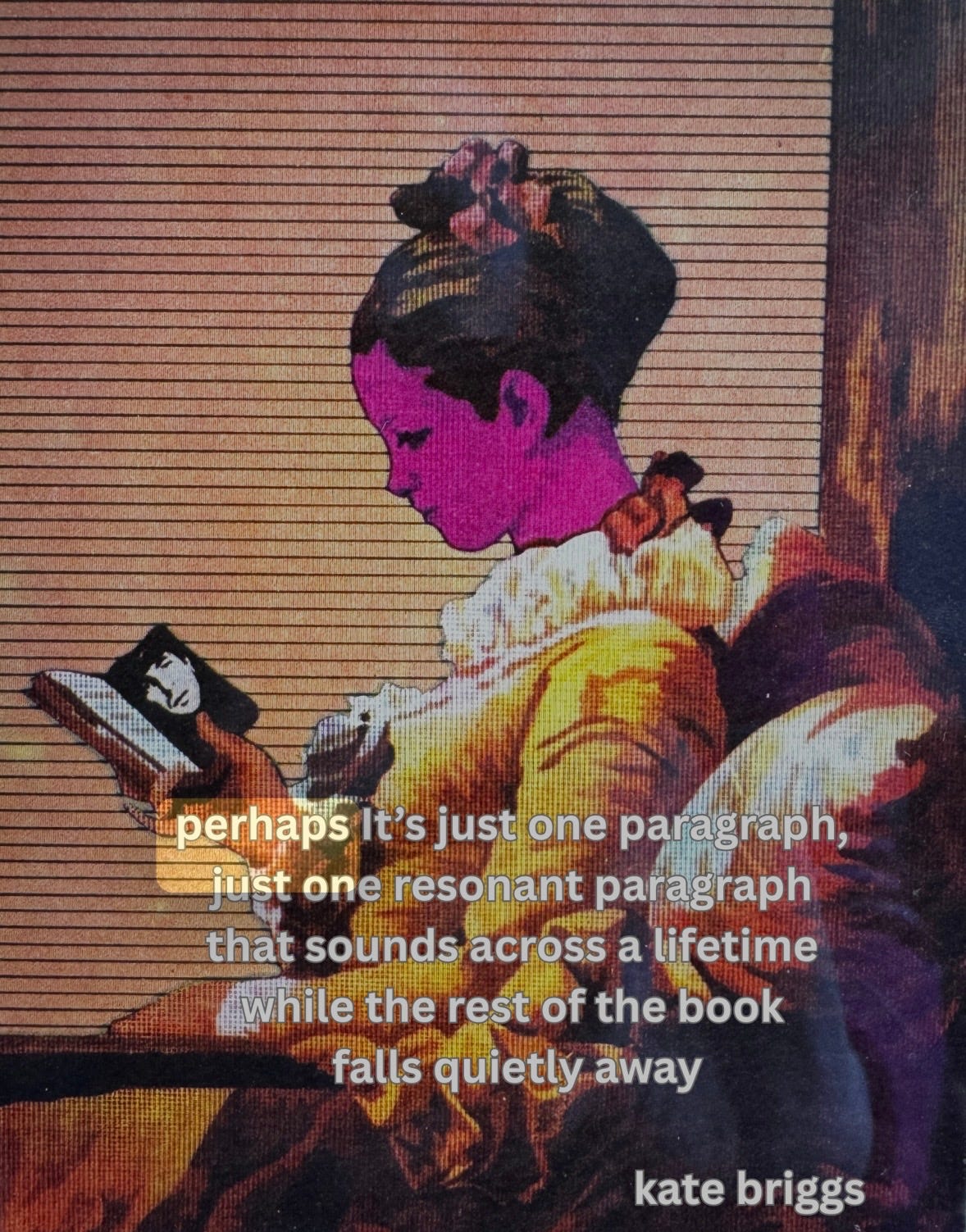
“Perhaps it’s just one paragraph, just one resonant paragraph that sounds across a lifetime while the rest of the book falls quietly away.” (Kate Briggs, This Little Art)
Likely all of us have had this experience once or many times in our reading lives, and often our bodies recognize it before our minds catch up with what Kate Briggs describes here:
There are sentences, half-lines, parts of pages that I happen across and find myself holding on and returning to because they produce in me something like a flash, a stun-gun of language,...a moment of truth. ‘The coming morning reaches its long arm into the night.’ Yes. That’s it, here’s the dawn. Yes, that is exactly it. Here’s the truth of it as I have experienced it in life or: as life is now reconfigured to accommodate its truth…here is life ‘phrased’.” (emphasis my own)

2. The tone of books (and the mental rooms we enter through books)
Tone, written by Sofia Safira and Kate Zambreno, is a book and a study about one of the most indefinable qualities of literature. Reflecting on a number of texts and books they read together, the two authors offer tentative answers to this question:
What is tone?
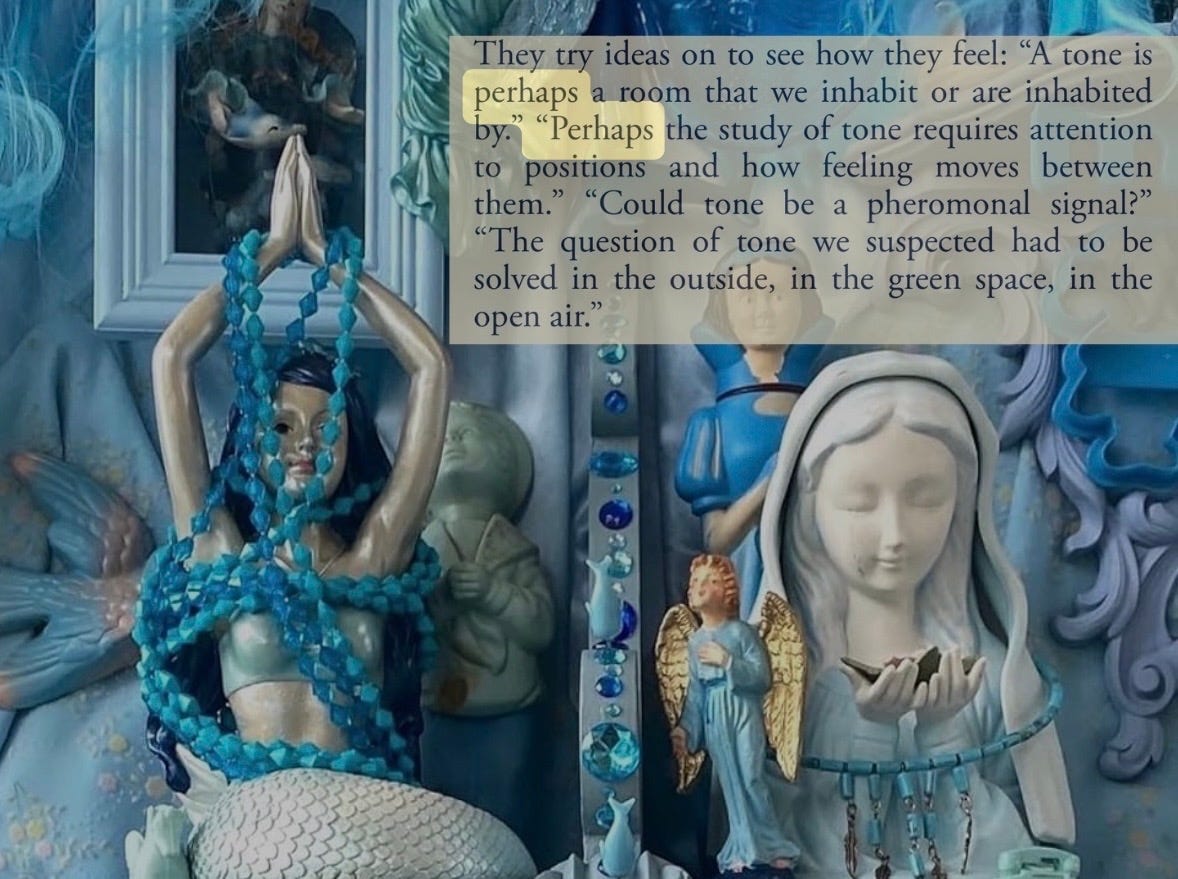
Reminding us that we often read a book less for its characters or plot but more for the diffuse atmosphere it provides, Safira and Zambreno try out these definitions:
“A tone is perhaps a room that we inhabit or are inhabited by.”
“Perhaps the study of tone requires attention to positions and how feeling moves between them.”
I recognize my own encounters with the tone of the books I read, in the way they may invite me to spend time inside alternative (or aligned) ways of feeling and relating to the world. We inhabit a book, and the book, in reverse, also starts to inhabits us.

3. Not a bad book recommendation
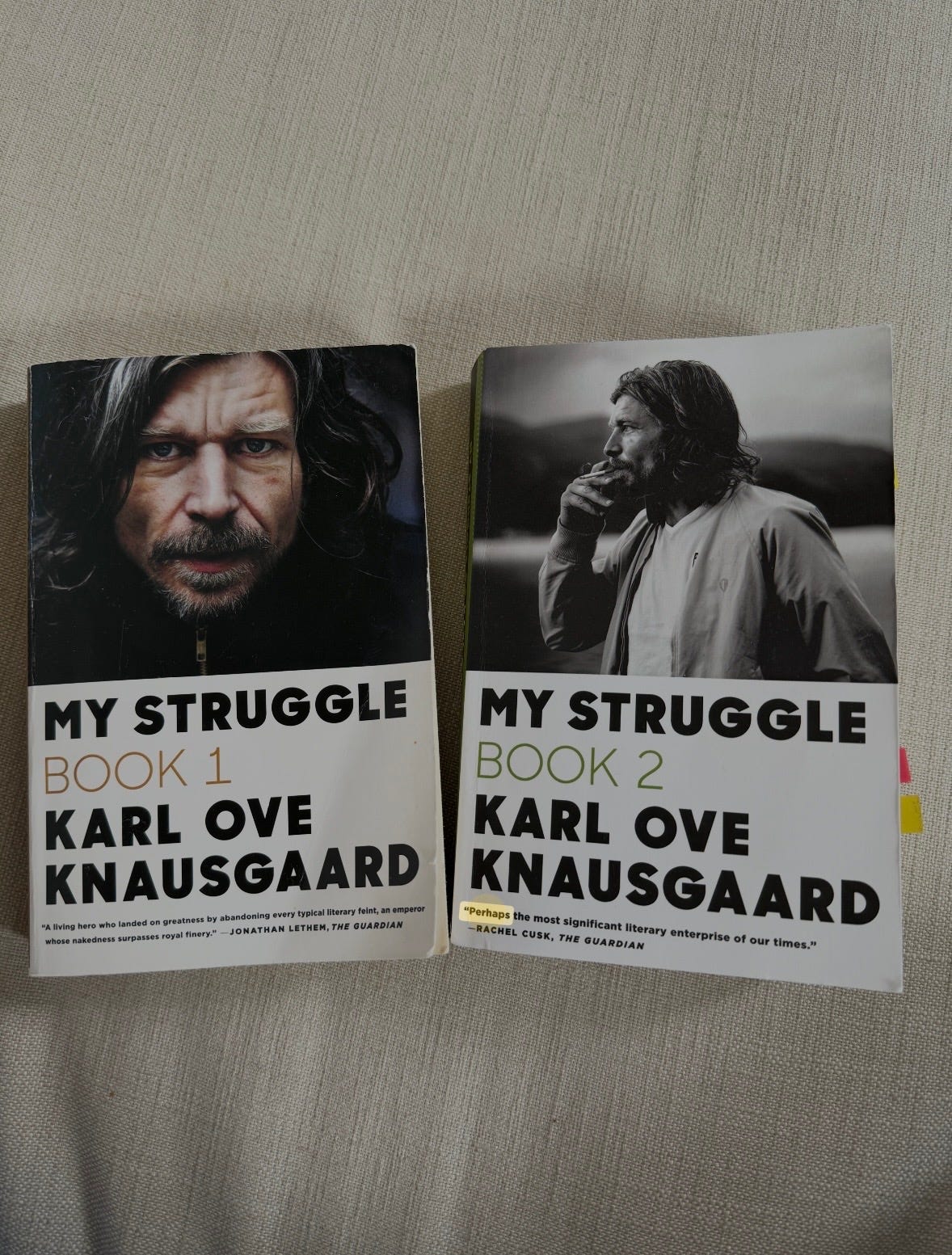
“Perhaps the most significant literary enterprise of our times.” (Rachel Cusk on Karl Ove Knausgaard’s My Struggle series, in The Guardian)*
*I’m biased toward this quote. I love this series and wrote about it in 2025 in three favorite books

4. What eyes and heart may have in common
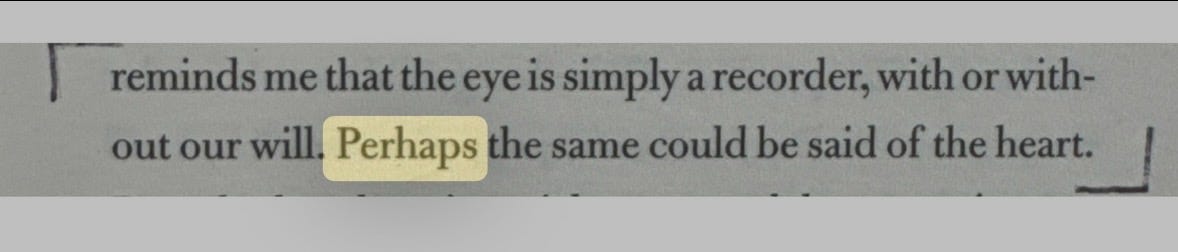
“[This] reminds me that the eye is simply a recorder, with or without our will. Perhaps the same could be said of the heart.” (Maggie Nelson, Bluets)
In the context of this passage from her book, Nelson remembers how she once worked ten-hour shifts at a restaurant that was painted in bright orange colors, and how she subsequently started having dreams of the same dining room in pale blue, the complementary color of orange. As the eye involuntarily records what it encounters repeatedly, Nelson then wonders if our heart functions in the same way. Does what we experience as love, loss, beauty, neglect or tenderness continue to color our inner life long after the original experience has disappeared?
I love thinking about the ways our perception, and the ways we experience reality, feel participatory, and influenced by what we believe is possible.

5. The notes we take
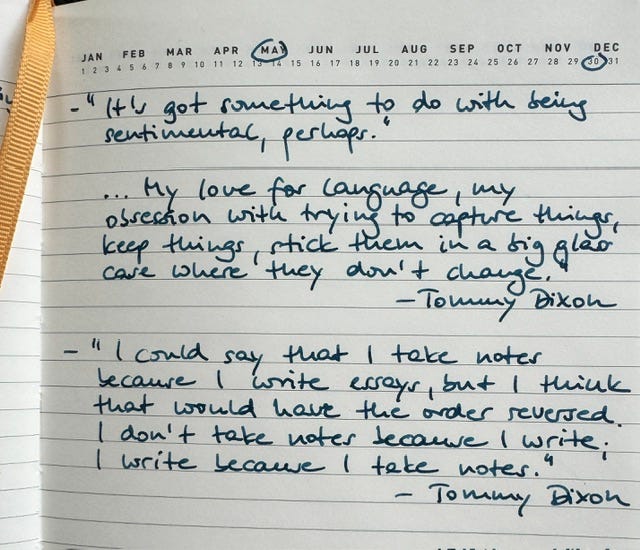
“It’s got something to do with being sentimental, perhaps.” (Tommy Dixon, in his essay On Keeping a Notebook)
Tommy Dixon’s reflections on his note-taking resonate a lot, and how the impulse to write feels to him:
My love for language, my obsession with trying to capture things, keep things, stick them in a big glass case where they don’t change.”
I could say that I take notes because I write essays, but I think that would have the order reversed. I don’t take notes because I write; I write because I take notes.
Exactly! I also write to process my life, and what I read, in order to remember things I noticed, felt or thought about—similar to what Didion wrote about her own notebooks in On Keeping a Notebook: “Remember what it was to be me: that is always the point.”

6. “Please use AI”
In his viral Substack essay Please Use AI, Shawn Smucker wrote:
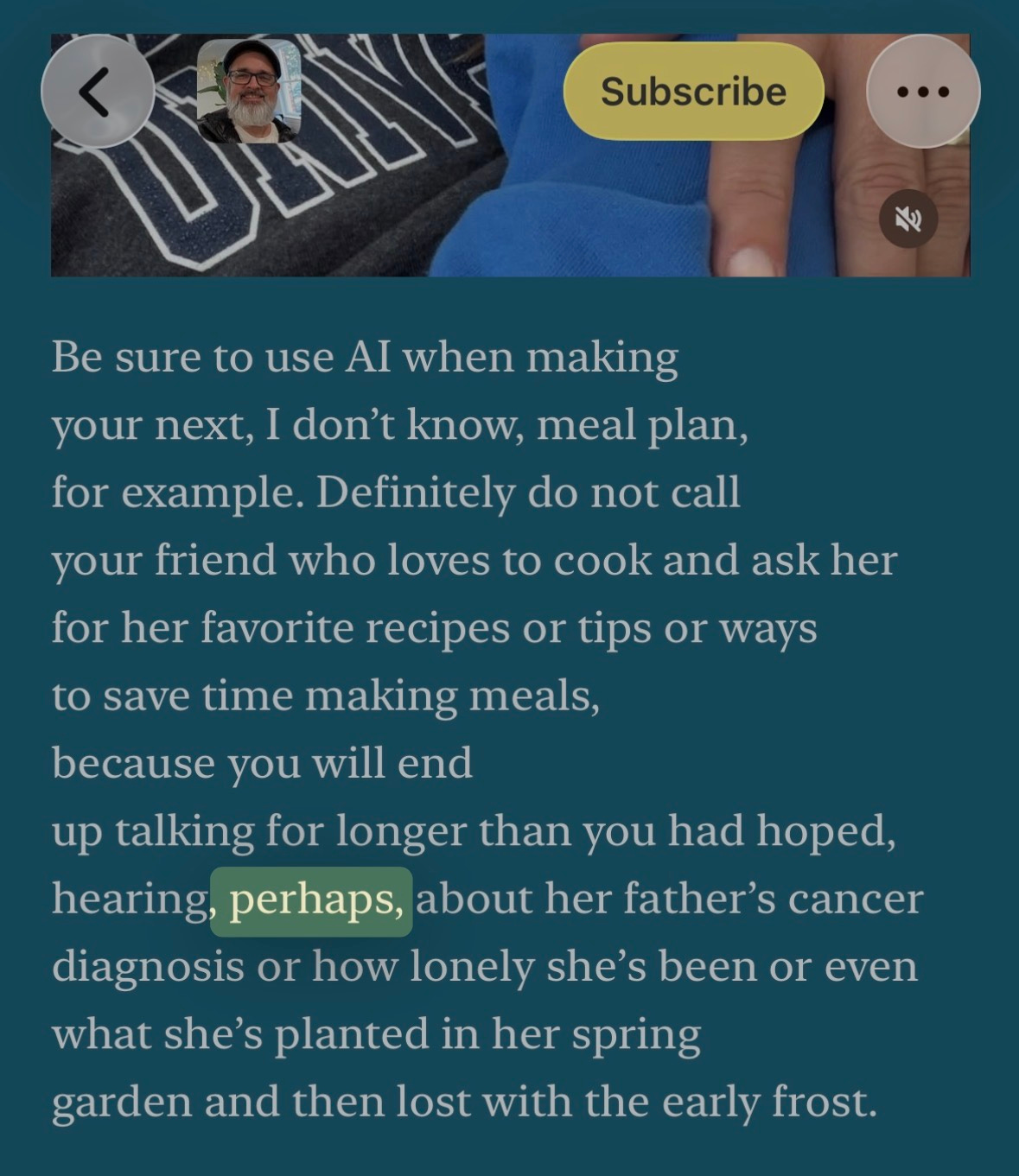
“Be sure to use AI when making your next, I don’t know, meal plan, for example. Definitely do not call your friend who loves to cook and ask her for their favorite recipes or tips or ways to save time making meals, because you will end up talking for longer than you had hoped, hearing, perhaps, about her father’s cancer diagnosis or how lonely she’s been or even what she’s planted in her spring garden and then lost in the early frost.”
Perhaps—no, more than perhaps—Smucker is on to something. Being in a direct relationship with your family and friends, and the world in general, remains the deepest form of nourishment we need as humans.

7. Can we ever be perfectly candid with ourselves?
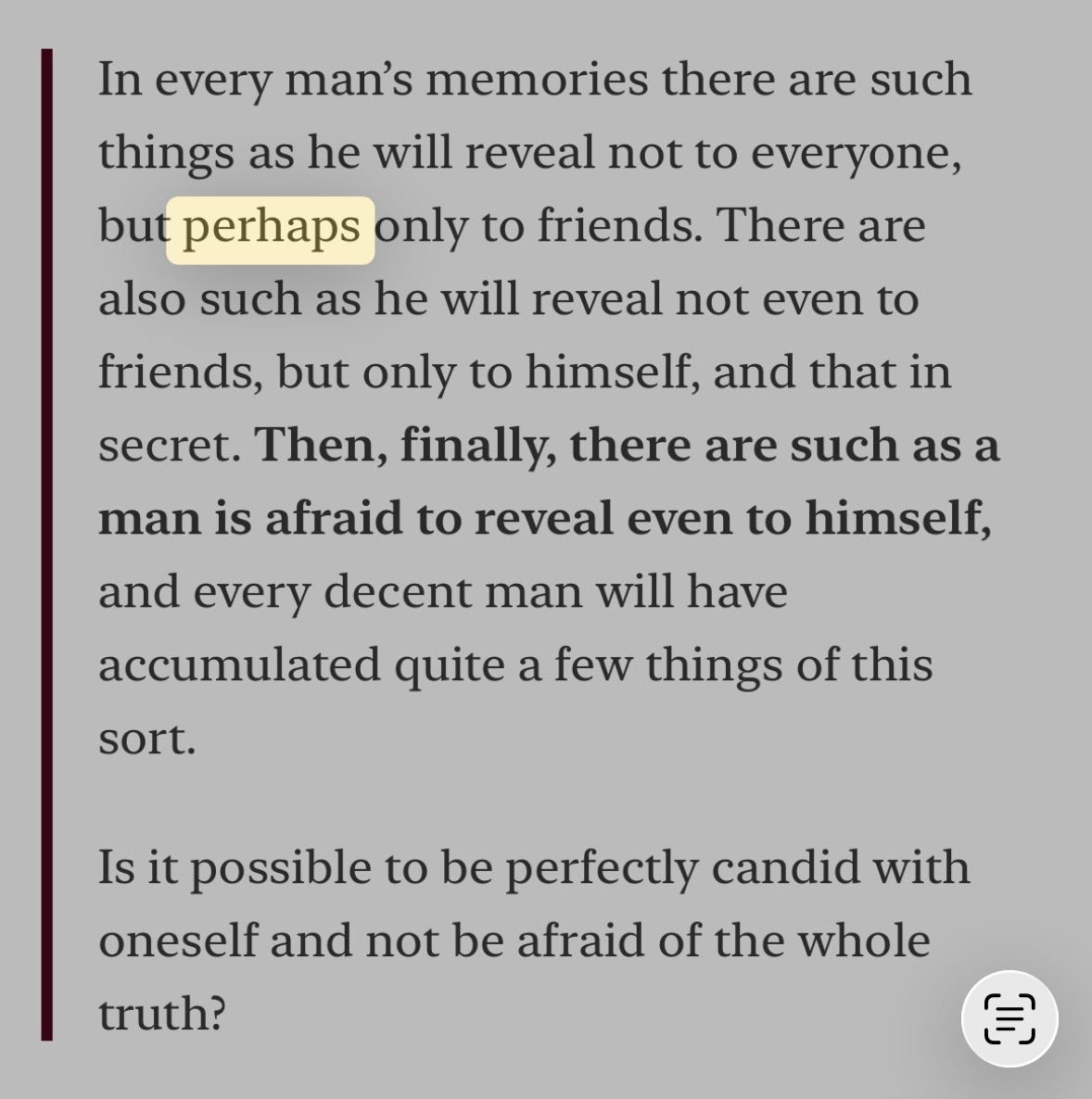
“In every man’s memories there are such things we will reveal not to everyone, but perhaps only to friends. There are also such as he will reveal not even to friends, but only to himself, and that in secret. Then, finally, there are such as a man is afraid to reveal even to himself, and every decent man will have accumulated quite a few things of this sort.
Is it possible to be perfectly candid with oneself and not be afraid of the whole truth?”
(Dostoevsky, Notes from the Underground, quoted from the essay Formative by Nix)*
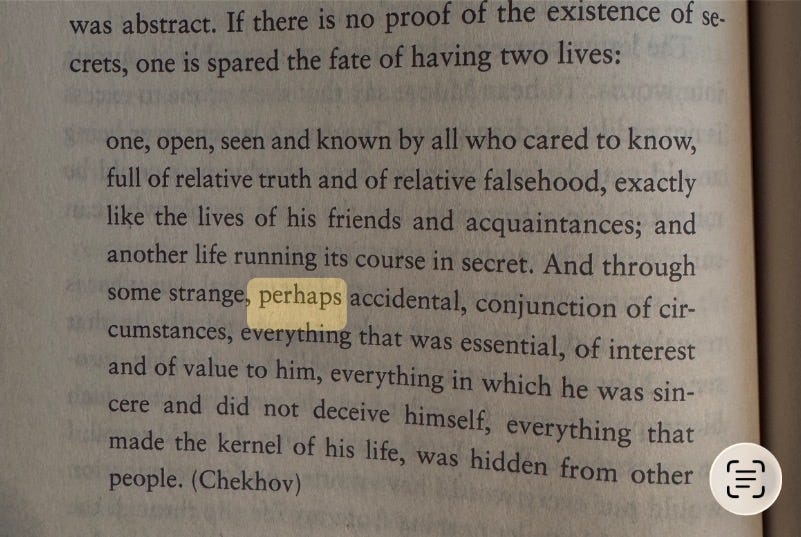
* Also check out my footnote with a passage by Checkhov; it rhymes beautifully with the Dostoevsky quote.1

8. Inner authority > outside judgment
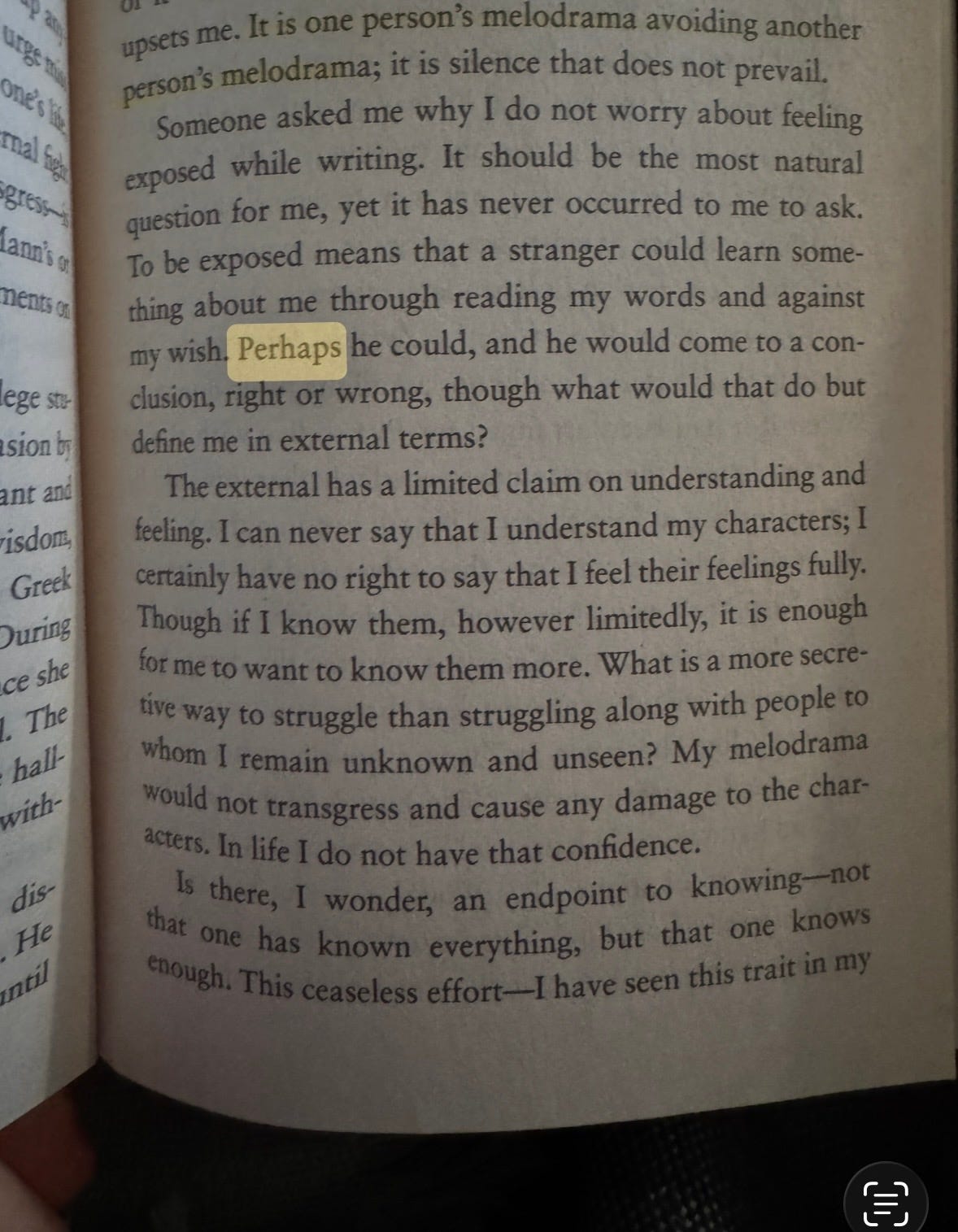
In Dear Friend, from My Life I Write to You in Your Life, a book about identity, art, and depression, the Chinese-American writer Yiyun Li writes:
“Someone asked me why I do not worry about feeling exposed while writing. It should be the most natural question for me, yet it has never occurred to me to ask. To be exposed means that a stranger could learn something about me through reading my words and against my wish. Perhaps he could and he would come to a conclusion, right or wrong, though what would that do but define me in external terms?”
Li makes a distinction between who she is and what other people think she is, and much of this applies to every writer, I think. Yes, somebody may know me, or read my writing, and believe they have figured me out. But whatever conclusion they reach belongs only to their understanding of me, and not to my actual self (will I ever even fully arrive at figuring myself out? Of course not).
My own fear of “exposure” is certainly something I’ve had to, and am still, working through in my own writing. Li helped me loosen that grip and write “the actual thing” and what feels meaningful to me, instead of worrying too much about how other people may define or label me—like small acts of placing my inner authority above outer judgement.

9. Our inner life determines which nourishment we need
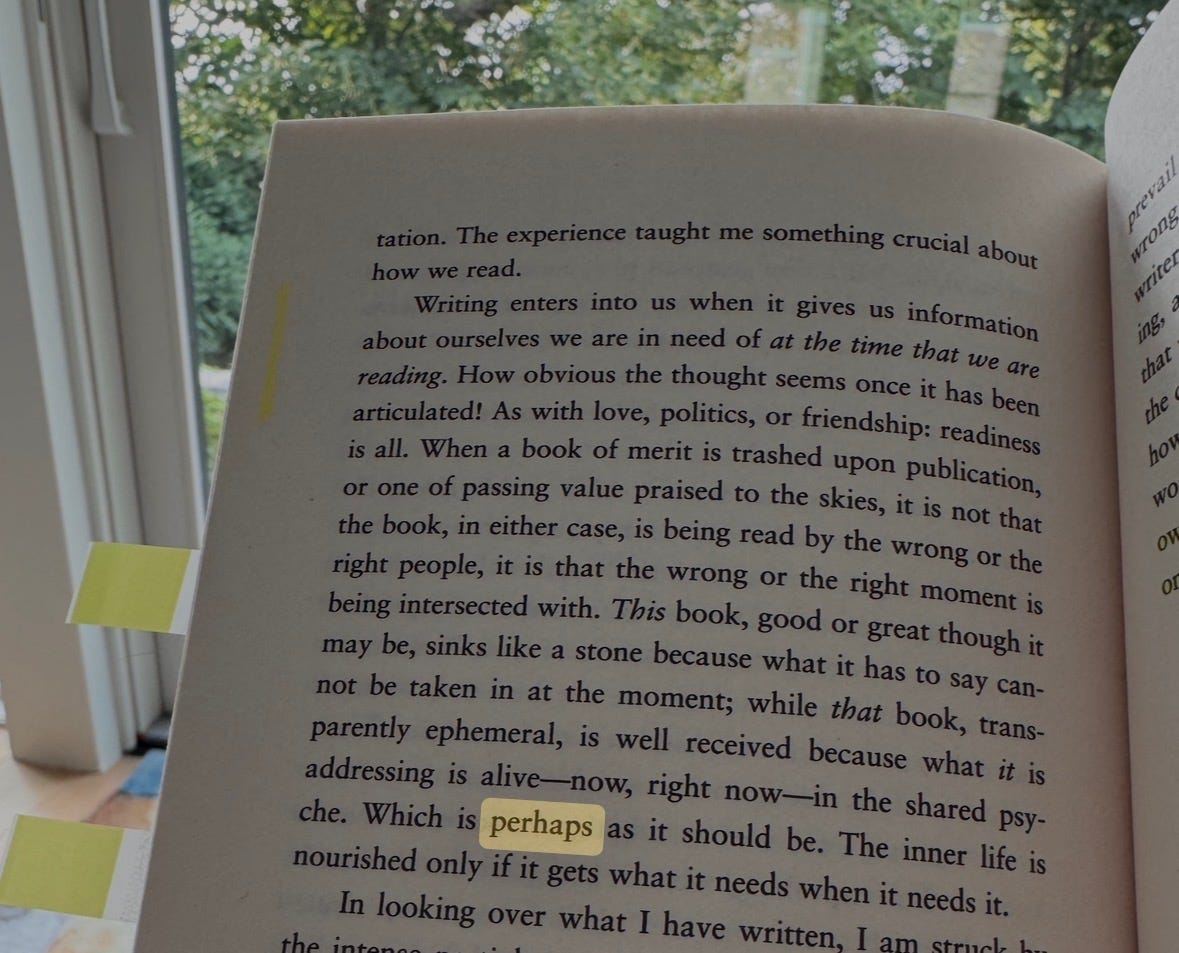
“Which is perhaps as it should be, the inner life is nourished only if it gets what it needs when it needs it.” (Vivian Gornick, The Situation and the Story)
To understand what Gornick is getting at in one of my favorite craft book on writing, it’s worth quoting the whole passage:
“Writing enters into us when it gives us information about ourselves we are in need of at the time that we are reading. How obvious the thought seems once it has been articulated! As with love, politics, or friendship: readiness is all. When a book of merit is trashed upon publication, or one of passing value praised to the skies, it is not that the book, in either case, is being read by the wrong or the right people, it is that the wrong or the right moment is being intersected with. This book, good or great though it may be, sinks like a stone because what it has to say cannot be taken in at the moment; while that book, transparently ephemeral, is well received because what it is addressing is alive-now, right now—in the shared psyche. Which is perhaps as it should be. The inner life is nourished only if it gets what it needs when it needs it.” (emphasis my own)
This of course confirms what I experience over and over again: a book so often finds me when I’m ready for it.

10. Everything is part of the journey
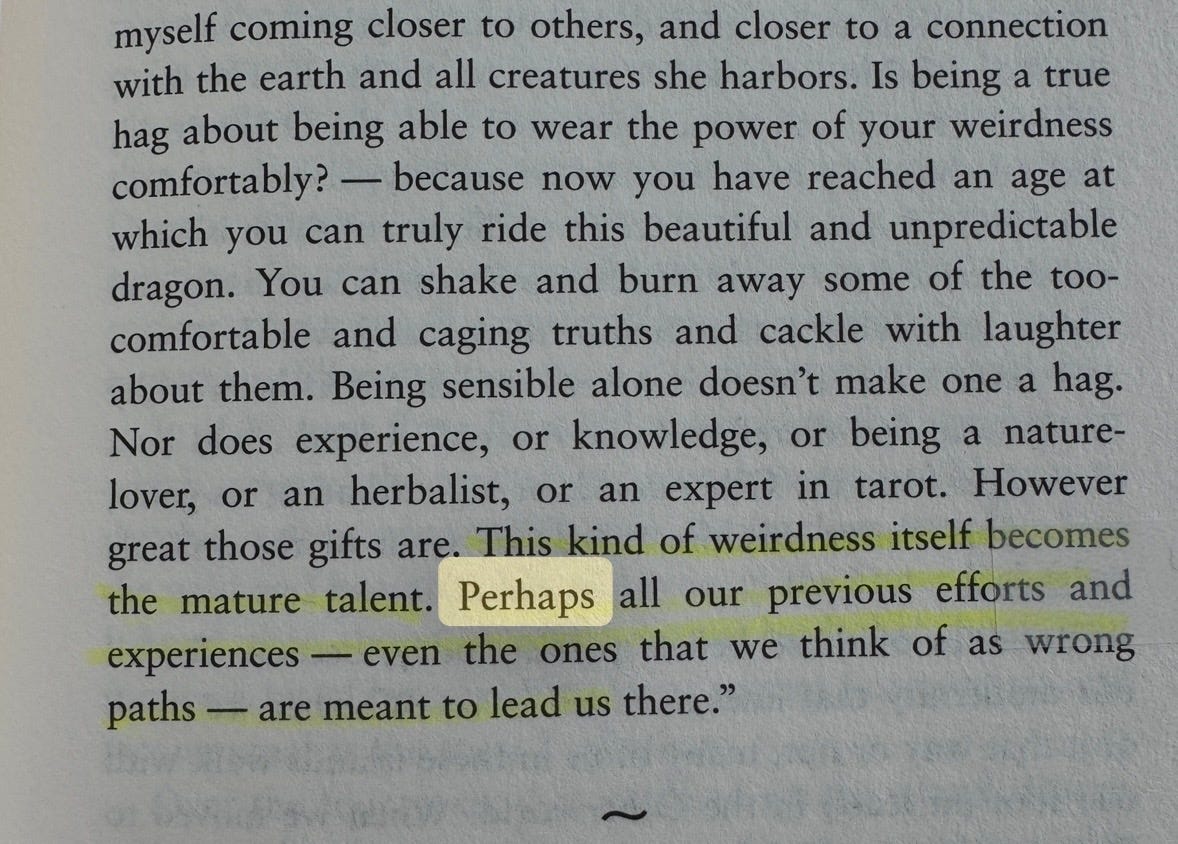
“This kind of weirdness itself becomes the mature talent. Perhaps all our previous efforts and experiences — even the ones that we think of as wrong paths — are meant to lead us there.” (Sharon Blackie, Hagitude)
In this passage from Hagitude, the Scottish writer Blackie is speaking primarily about women figuring out what being—or becoming—a woman means. As Simone de Beauvoir wrote in The Second Sex: “One is not born, but rather becomes, a woman.”
Her insights, however, seem to apply universally to all of us. Perhaps our experiences, even the mistakes, detours, and oddnesses that once felt like wrong turns, were all necessary for a more mature and integrated version of ourselves to emerge. Perhaps becoming is then also a matter of retracing, and sometimes reinterpreting, the path we’ve already traveled, and where it leads from here.

11. There’s a beauty that comes with time and distance
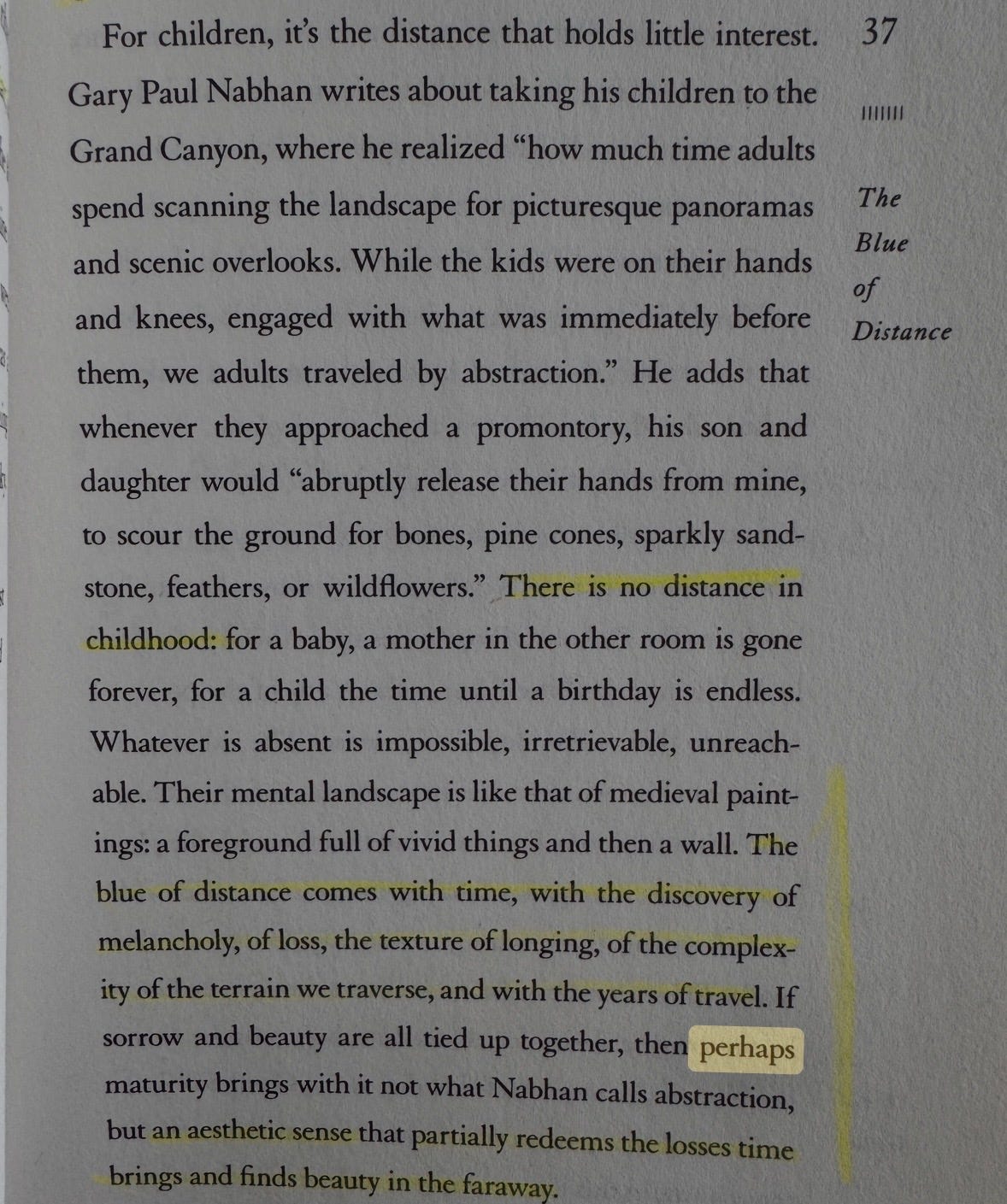
“The blue of distance comes with time, with the discovery of melancholy, of loss, the texture of longing, of the complexity of the terrain we traverse, and with the years of travel. If sorrow and beauty are all tied up together, then perhaps maturity brings with it not what Nabhan calls abstraction, but an aesthetic sense that partially redeems the losses time brings and finds beauty in the faraway.” (Rebecca Solnit, A Field Guide of Getting Lost)
From one of my favorite writers. I especially love Solnit’s phrase of “the texture of longing” and Solnit’s idea that memory, including all that is lost or becomes absent, and with all its layers and even contradictions, deepens our capacity to see “beauty in the faraway.”
I remember that somewhere else in the same book, Solnit describes this as “being rich in loss.” I think of this often.

Why poetry duh
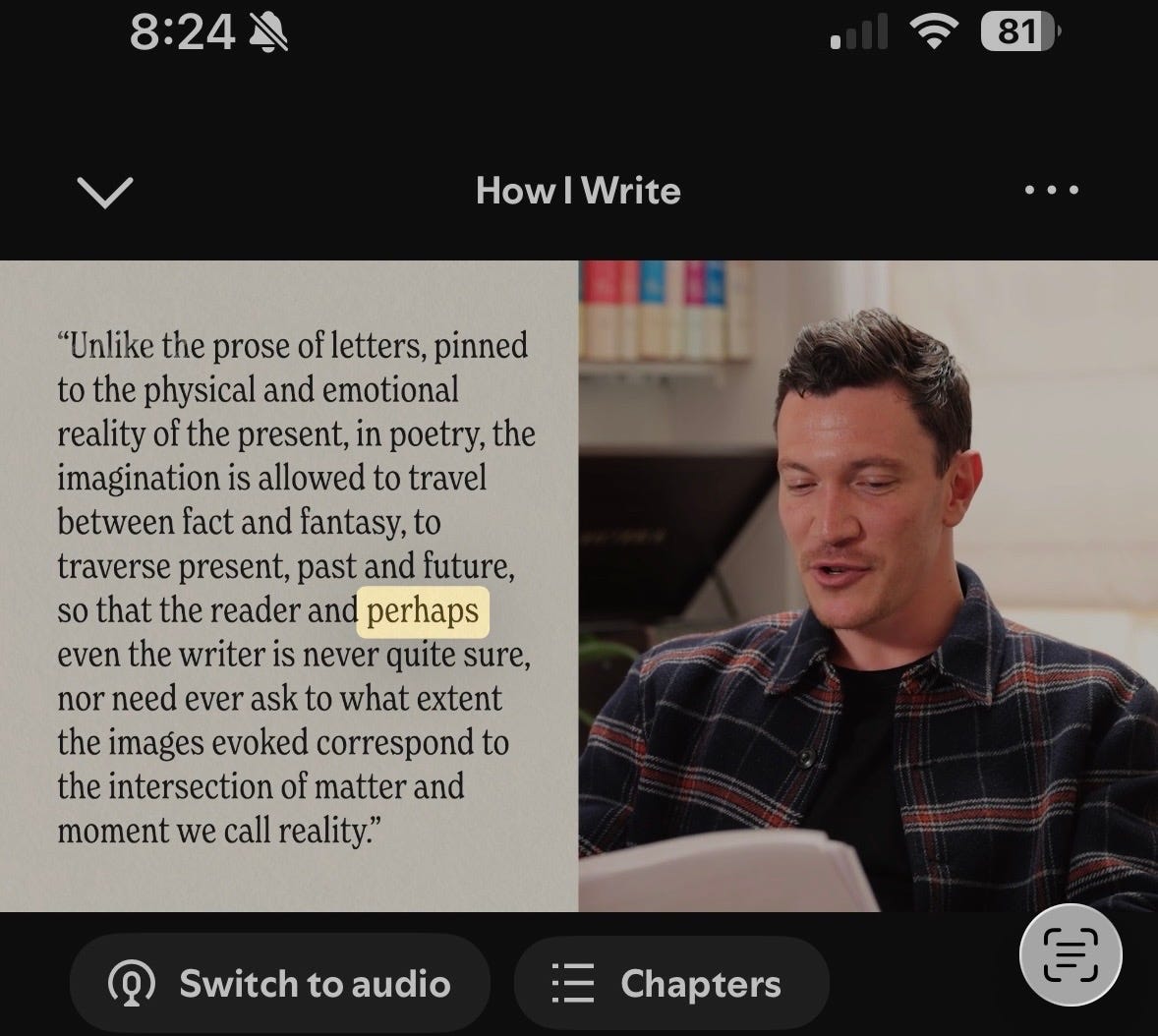
“Unlike the prose of letters, pinned to the physical and emotional reality of the present, in poetry, the imagination is allowed to travel between fact and fantasy, to traverse present, past and future, so that the reader and perhaps even the writer is never quite sure, nor need ever ask to what extent the images evoked correspond to the intersection of matter and moment we call reality.” (Maria Popova, in conversation with David Perell, on How I Write)
Read that again. What a quote. I know I should read, and maybe start to write, more poetry. It is consoling to hear how it also took Maria Popova, one of my blogging idols, time to find her way to poetry. In my opinion, it’s absolutely worth listening to this whole conversation.
Maria Popova is describing reality as collision point between the extended world (“matter”) and our lived experience (“moment”) = when a consciousness encounters the world.
For example, the reality of a tree is not perceived in the same way by a grieving person, a botanist, or someone who remembers the trees they climbed in during childhood. The matter is the same per se, but not how one experienced it in time, in one’s consciousness. I’ve come across this same phenomenological idea in books or texts I read by Proust, Woolf or Blake, following the same underlying question: how do we relate to the world before us, and how does this world enter us?
Poetry, or a more poetic way of seeing the world, gives us access to the field of what it was like, and not only what happened. So perhaps the key to meaning in life is experiential truth (truth that we have felt, experienced), and the living experience and the perspectives we take on them have the power to change us.
Thank you so much for walking with me through this “constellation” and my experiment with form. If you liked this, you might also enjoy my essays around similar topics like memory, consciousness, the creative impulse, and the power of alchemy in reading and writing.
Now, please share with me:
What does the word “perhaps” bring up for you? For example, what comes up when *you* search for the word perhaps in the photos you store on your phone?
In my upcoming second mixtape, I might try to capture a playful constellation of insights around the words “returning home.”

A huge thank you to Rachel Parker and Michelle Varghese for their editing help, and for encouraging me to explore this format!
Chekhov with his take of what remains hidden of us from the world, even when we (think we) know ourselves
Brigitte, you have such an extraordinary ability to dive deep ... in *any* direction. This is one notable example.
If you hold close to nature, to what is simple in it, to the small things people hardly see and which all of a sudden can become great and immeasurable; if you have this love for what is slight, and quite unassumingly, as a servant, seek to win the confidence of what seems poor – then everything will grow easier, more unified and somehow more conciliatory, not perhaps in the intellect, which, amazed, remains a step behind, but in your deepest consciousness, watchfulness and knowledge.
- Rainer Maria Rilke