

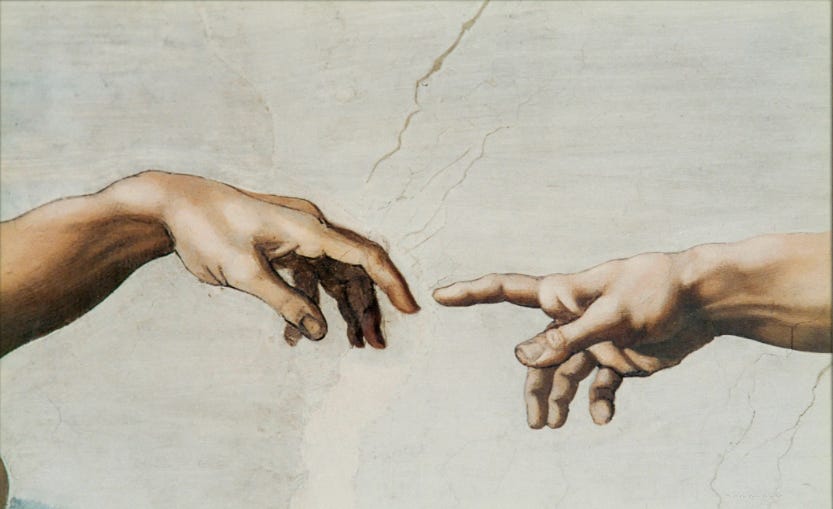
Irish poet David Whyte begins his essay Background with a striking observation:
“Foreground dominates our lives, it overestimates in importance and hides the greater context from which it has emerged. The neglect of background is the source of much of our present loneliness and most definitely, our present unhappiness.”
There is a strange paradox in how we experience the world: what we most often notice and deem important is rarely what matters most. Our attention clings to the sharp, defined, immediate edges of reality: the tasks, the images that blaze our screens, the measurable, the seemingly simple solutions to problems. This is the foreground, the crisp scaffolding of perception that promises clarity and certainty. But like the surface of water, the often clear and static surface often obscures the deeper and darker currents beneath—the background.
What Whyte describes as “emerging from the background” is something subtle yet more essential: the vast relational web of experiences, rhythms, and the hum of the elements and seasons cycling through us. The background are the unspoken exchanges that deepen our relationships, and the felt sense of truly belonging to the world. It’s what gives the foreground its meaning.
In short, the background is the unseen thread that underlies reality. It’s the world flowing through us in every moment—more spacious, ambiguous, and alive than the rigid structures we like to impose on how we perceive reality. We crave order and control, reflecting our deep fear of uncertainty and the unknown. And, let’s be real, our fear of dying.
The shift toward the foreground, an longstanding bias since Plato, was accelerated by the rise of industrialization, scientific rationalism, and the cultural glorification of precision and control—developments that reflect Dr. Iain McGilchrist’s seminal work on what he calls left hemispheric dominance.1 The left hemisphere loves to trump the right hemisphere, prioritizing measurable clarity over small parcels of reality instead of the fluid, relational, and intuitive ways of knowing that the right hemisphere excels at. Over time, a narrowing focus has increasingly left us disconnected from the richer, more embodied sense of reality that once shaped our experience.
Some remaining native tribes, for example the Anlo-Ewe of southeastern Ghana, still live in a way that reflects a deeper harmony with the world. The Anlo-Ewe are renowned for their sensory awareness, particularly their sense of balance and proprioception, which connects them to their environment in profound ways. They perceive themselves as part of a relational web, attuned to the movements of animals, the presence of water, and the cycles of the earth—guided by the intelligence of their bodies paired with the wide awareness of their minds.2 Their sense of time is attuned differently too, rooted in the present moment and guided by natural patterns and rituals, instead of our rigid linear conceptions of time. These practices, shared by other Indigenous cultures like the Western Apache, Inuit, and Māori, offer us a glimpse into what it means to live more wholly.3
By contrast, our Western culture can be called ‘whole-blind,’ a term used by embodiment teacher and author Philip Sheperd,4 which reflects our way of feeling and relating to the world as isolated, separate entities, disconnected from the fluid, relational web of life. One of the most powerful forces driving this disconnection is our reliance on language, a tool that shapes how we perceive and interact with reality. Language, with its abstract form, draws us into the foreground. Words like to categorize and fragment the world into fixed, conceptual representations. This is very helpful to solve problems and organize our world, but also detaches us from the aliveness of immediate experience—a bell jar of our own making.
If language often confines us to the foreground, it also offers ways to move beyond it. Metaphor and poetry, in particular, resist the pull of abstraction by creating more space for the depth of lived experience.5 Poet Robert Frost framed this perfectly when he wrote,
"A poem begins as a lump in the throat, a sense of wrong, a homesickness, a love sickness. It is never a thought to begin with."
To ground this idea of relational truths beyond words, look at this photo—a fitting counterpart to the felt experience that a poem may be able to evoke. Taken just a few days ago, it captures the very moment when a father embraces his daughter for the first time after 15 months of separation after being held hostage.6
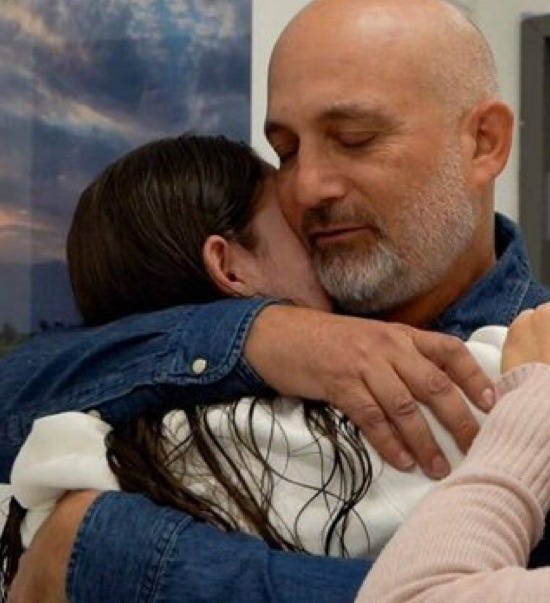
The photo itself is static, a fixed fragment of time. It cannot fully capture and put us inside the flow of this moment for father and daughter—their beating hearts, the warmth of their skin, the catching of breaths, the overflow of emotion, but it gestures toward it. Looking at it, I feel a lump in my throat. Without needing to label or rationalize what I see, I can open myself to a visceral awareness. Feelings of homesickness and of love sickness emerge—all contained in this moment of presence: I intuitively pick it all up, beyond words and categorizing thought.
The background, like the moment in the photo, may remind us what the foreground forgets: that meaning is shaped by the movement and flow of life, and in our participation in it. It may be found in a dancer’s arm moving in grace, in a daughter’s breath catching, or when locking eyes with a beloved animal. The wild peace found in gestures and every moment, at least potentially.
I am not when I think. Rather, I am when I relate.7 Reclaiming our connection to the background means stepping beyond the isolating confines of thought and back into the flow of life itself. It’s time to rewrite our story as part of the web of life. It’s wakeful, waiting for us—here, in the present.
Iain McGilchrist, The Master and His Emissary: The Divided Brain and the Making of the Western World (2009); The Matter with Things: Our Brains, Our Delusions, and the Unmaking of the World (2021)
Philip Sheperd, in “Radical Wholeness: The Embodied Present and the Ordinary Grace of Being” (2017), cites Kathryn Linn Geurts’ “Culture and the Senses: Bodily Ways of Knowing in an African Community” (2003) to highlight the Anlo-Ewe’s sensory awareness and relational orientation to their environment.
An interesting source for secondary reading is Rebecca Solnit’s “A Field Guide to Getting Lost” (2006), in which she draws on Keith Basso’s “Wisdom Sits in Places: Landscape and Language Among the Western Apache” (1996) to illustrate the relational orientation of the Apache to their environment and the importance of place-names in encoding cultural knowledge.)
Sheperd, Radical Wholeness
There are many other important gateways to the background as understood here, like art, music, somatic practices, just to name a few. And yes, they deserve much more space than a footnote mention!
The reunion of Israeli hostage Naama Levy with her father on January 25, 2025
In this reference, I’m mixing some Descartes and Shepherd
Brigitte, this is fabulous. So well-written, so rich. Great examples. The photo speaks /shouts volumes both from foreground and background. It encapsulates life itself.
“I am not when I think. Rather, I am when I relate.”
This has a deep spiritual meaning if one considers ego (thinking) vs soul (our soul relating with other souls and experiencing the commonality of Source Soul/God/Creator/All That Is, etc., however one envisions or names this. The universal experience of relating is what matters.).
Brilliant, brilliant piece. I loved it. So well done. It can hardly be overstated how important this is today imo.
Brilliant essay, Brigitte. So many things came to mind as I read this:
• The oft-overused analogy of an iceberg and how the vast majority of it is below our sight or, more applicably, our conscious awareness.
• The left-brain dominance in our Western world, especially since the Industrial Revolution.
• The popularity of (and, one can argue, growing addiction to) "memes" and quick sound bites, another indication of our need to get quick-fix glances (and knee-jerk answers) by focusing on the foreground, to the exclusion of the holistic, more nuanced background.
Your essay reminded me of the time a friend tried to explain to our Sunday coffee gang about the inherent limitation of language. Another of our motley caffeine klatch, a loving, brilliant fellow with a very logical bent, asked him, repeatedly, to try to *explain* this phenomenon in a more understandable fashion; the irony was lost on him, while the rest of us suppressed giggles.
This is very well thought out. Nicely done!