

“I think this is important: memories and ideas happen in a place. An essay is a place for ideas; it has to feel like a place. It has to give one the feeling of entering a room.”
— Elisa Gabbert, in “The Essay as a Realm”
In my first essay I ever published here on Substack, I took an imagined walk through the rooms of my childhood home. I resurrected incredible detail before my mental eye: the fabric’s texture of my father’s armchair and the mold where he had just sat. How I felt the softness of the brown carpet beneath my five-year-old fingers as I huddled there, listening to my then-favorite story on vinyl: Kimba, the White Lion. I heard my mother’s younger voice coming from the kitchen; she was laughing with my older sister, still a child herself.
Writing this essay and traveling back to these rooms was a beautiful and insightful experience. I was surprised about the emotional weight I still sensed in them, every room a sort of museum with a display of personal artefacts and memories. Some mournful and others joyful and bright, their aliveness stoking my imagination.
Rooms continue to carry a tone, an atmosphere. They embody a subtle reciprocity we may still sense: the moods and attitudes we left behind, but also the many sensory imprints they left on us. We built connections between their objects and our memories, weaving the real into the poetic—or horrific—imaginations of our minds.
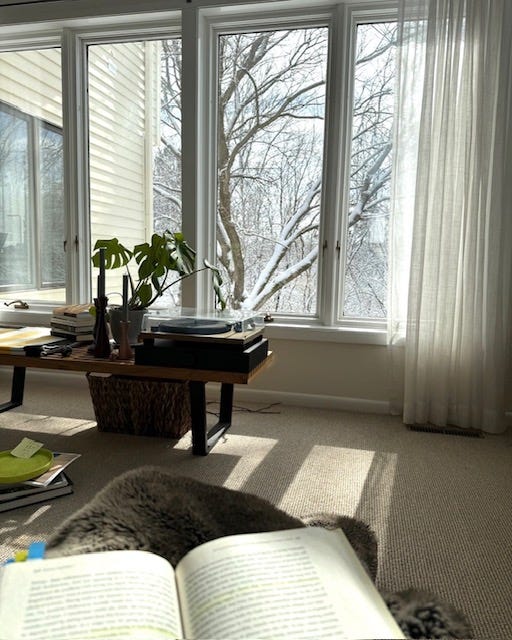
And what happens when the objects we encounter are words?
In Tone, Sofia Samatar and Kate Zambreno explore what constitutes the tone and atmosphere in books. “[It is] perhaps a room we inhabit and are inhabited by. It is the interior that surrounds and the exterior that invades. Something we must listen to, attune to, with the necessity of silence. Are these paragraphs, here, the rooms in which we attempt to meet [too]?”
This feels true to me, and reminds me how I like to spend time in a book’s diffuse atmosphere and aura. What I am intuitively after, perhaps, are the subtle truths about human life that reveal themselves inside the psychologically pressurized rooms of a book’s plot or characters. A reader recognizing himself, at least in part, in others.
The feelings of being within [a] book’s aura: nearness and distance simultaneously. — Petya K. Grady
It’s Saturday morning, and as I’m typing these words on my laptop, the house lays still, the dog warm across my feet. I look around the room. The physical spaces we inhabit carry atmospheres that act upon us, often beyond our conscious awareness. I love combining colors, objects and textures to help shape the atmosphere in my rooms. I try to notice how the tones and paths of light change throughout the day and with the seasons. Earlier, for example, I entered my kitchen to find the morning light gathering in beautiful shapes on the floor, turning the oak wood golden and lacing it with the shadows of a plant.
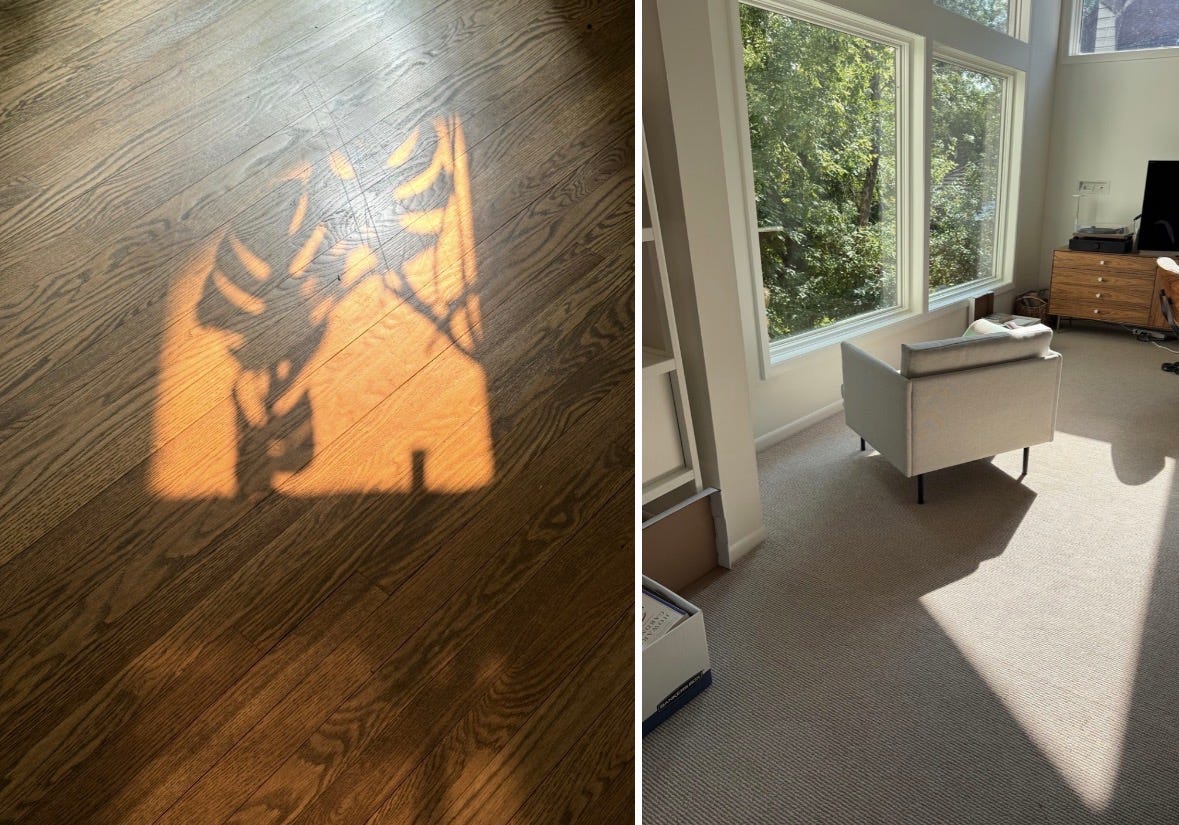
Rooms, through their distinctive character and presence—or the remaining traces of what once happened within them, now absent but still remembered—can shift our mood and, in the best case, lighten the heart. As Elisa Gabbert writes, “A room is a mood, and we need different moods, small and capacious.”
(In my essay The secret sense of time, I described how the smell and spell of firing wood in my outdoor hemlock sauna carried me back, Proust-like, to memories of my childhood and a kind of secret sense of time I believe we carry within us:)

Now what if I looked at the concept of rooms in the context of time? Couldn’t even an ordinary day be its own kind of room, with its particular atmosphere that enters and colors our experience of life?
Each day could be imagined as its own little room inside a large home called life—intimate, partial, sensory, fragmental, unfinished—and open to our later subjective and selective remembering and interpretation. These rooms are furnished by what we pay attention to, want to believe and hope, and what deluded us. Each day then represents a renewed practice of being present to the flow of life, and the ways we filter our impressions through the lens and level of consciousness that we inhabit (or are inhabited by).
Each day sets a tone I enter. There are ways I can influence my mood and intention, certainly, but there’s one thing I cannot escape: spacetime. So I can only try to imagine this: What if I could somehow step out of my ordinary perception of time and see my life, and what I encounter(ed) in it, in its wholeness, all at once, as a fluidly moving sculpture for me to look at from different angles?
In his essay Days are Enormous, Henrik Karlsson writes about such imaginations in the context of Solvej Balle’s On the Calculation of Volume. In this book series, the reader enters the world of protagonist Tara Selter who becomes trapped in a single day. The date is November 18, and it repeats over and over and over again. Each morning, the rooms and routines of her daily life reset anew. Tara alone knows that time has become stuck, while everyone around her remains oblivious. Led by desperate curiosity, she begins to study this ever-repeating day, and herself in it, from many different angles.
Karlsson expands Balle’s fictional premise into a larger reflection on the nature of time and space:
Because we cannot move freely in the dimension of time, we experience reality as a series of three-dimensional moments succeeding one another. But if we could observe spacetime from the outside, reality would look like a 4-D object with time as its fourth dimension. Every chair and stone and person would reveal itself as a so-called world line–a four-dimensional object extending through time.
And:
In the same way that we can walk around a sculpture and see it from different angles, we would be able to observe the sculpture’s world line at different points in time—in the morning light, in the moment a child tries to climb the sculpture, in the moment the sculptor carved it, three hundred thousand years earlier, when the stone lay hidden in the bedrock. The sculpture would reveal itself as a four-dimensional object that (I’m told the theory of relativity says) it always was. Something similar happens in Balle’s series.
Imagine a day you lived in the past as a room you could enter and look at from different perspectives. Imagine even just a fraction of how even just one day intersected with other people’s lives, in all their complexities, nuances and beauty. Now widen the view to encompass your whole life as a temporal statue: yourself as a toddler, a teenager in high school, dancing with your friends or a lover, giving birth to or witnessing the birth of a child. Imagine, too, your future self. From such a vantage point, wouldn’t the person you are today appear much less fixed and final? Instead of seeing each version of yourself as partial, fragmentary, confusing, and incohesive, might you see the whole of your becoming as a beautiful, upward-moving spiral?
Once again, I go back to the rooms of my childhood home. When I enter them in my memory, I usually encounter myself at a particular age. I see the furniture as it was then, feel the particular atmosphere of that time, and meet my parents and sister as the people they were to me then. What if I could sit beside my seven-year-old self on the same soft brown blanket on my bed and look with her at all the selves still ahead: teenage me, woman me, mother me, friend to others me, reader me, writer me— all the selves I have been so fortunate to become?1
From this imaginative stance of observation, the horizontal plane of my lived days would morph into the sculpted vertical landscape of a life. Time would maybe begin to feel more like a vast, lived-in place I could enter and regard more freely from different sides, and take me close to what Oliver Sacks wrote toward the end of his life:
“I have been able to see my life from a great altitude, as a sort of landscape, and with a deepening sense of the connection of all its parts.” — Oliver Sacks
Rooms are defined by what’s inside and what’s outside of them. We return to the rooms we love and the ones that haunt us. Rooms may close in on us, may lock us in and separate us from others.
The ways I experience and compartmentalize reality is necessarily different from yours, dear reader. What moves you remains invisible and intangible to me, shaped as it is by a subjectivity different from mine. And yet, in this very moment, as you read my words, our worlds become entangled. My room of experience bumps up against yours, even if we may interpret these words differently.
In Outline, Rachel Cusk refers to a scene in Brontë’s classic Wuthering Heights:
Heathcliff and Cathy stare from the dark garden through the windows of the Lintons’ drawing room and watch the brightly lit family scene inside. What is fatal in that vision is its subjectivity: looking through the window the two of them see different things, Heathcliff what he fears and hates and Cathy what she desires and feels deprived of. But neither of them can see things as they really are.
What Cusk regards as “fatal subjectivity” is our tendency to perceive the world, and other people, through the lens of our own lives and the beliefs we carry. Heathcliff and Cathy do not see the Lintons as they are, but as their own emotional states reflected in them.
At its extreme, we may perceive our own closed-off-ness as an alienating atmosphere, similar to what we pick up on when we look at paintings by Edward Hopper. In his most famous artwork called Nighthawks, Hopper depicts four lonely figures inside a New York diner at night. In The Lonely City, Olivia Laing describes the painting’s gloomy atmosphere:
A livid yellow prison … a place of refuge, absolutely, but [also with no] visible entrance, no way to get in or out … from the street: an urban aquarium, a glass cell. … This is the kind of subtle geometric disturbance that Hopper was so skilled at, and which he used to kindle emotion in the viewer, to produce feelings of entrapment and wariness, of profound unease. … It was impossible to gaze through into the diner’s luminous interior without experiencing a swift apprehension of loneliness, of how it might feel to be shut out.
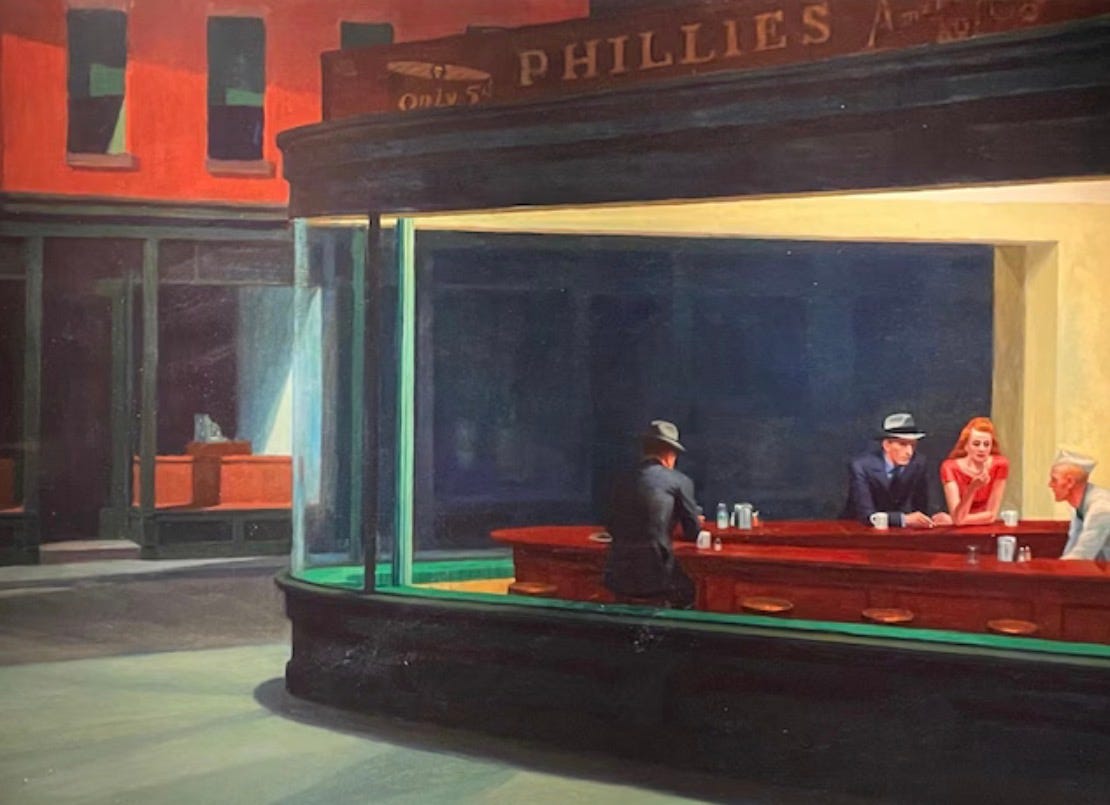
Shut out, cut off from the flow of life, we find ourselves imprisoned within our own distorted interpretations of what is happening—or once happened—to us.
Fortunately, with some distance and perhaps age, we can unlock some of these enclosed rooms and widen our field of interpretation and awareness. We aren’t trapped in an eternal return in this lifetime—we can change our beliefs and perspectives! We can reconsider and reframe the stories and commentary around what happened to us.
Writing about the rooms of my childhood helped me arrive at realizations of my own. I can help compose the atmosphere of my inner life by deciding what I wish to cultivate inside my beautiful and tender heart. I wrote:
This makes memory, in a way, a form of art, a creative act of mixing what we choose to recall with what strikes the surface of our memories unexpectedly.
Memory permits some poetic freedom, guided by the empathy, peace and grace I find in my favorite room of all: my heart. Memories, together with life as it unfolds, can then enrich me instead of merely take from me.
The rooms we inhabit are places that reach out to us; may they become more permeable spaces for life and love.
A huge thank you to my writing friends Rachel Parker and Michelle Varghese for helping me piece this essay together over time.
Credit for the cover artwork to Sofia Bonati.
Okay, too much “selfing” going on here; I imagine you get the point ugh.
I did NOT realize I was walking into a Christopher Nolan-esque piece when I opened this Brigitte…but I am here for it!
Truly, this was great.