

It’s still early when I sit down at my desk with coffee. Lush morning sunlight welcomes me, letting my sisters, the leaves, dance with their shadows. I let the silence dilate for just a moment, and notice a question circling in my mind, one I had seen on Substack just a day earlier: “What are your systematic ways of producing creative ideas?”
My response had been intuitive. Something about reading, idling, unstructured blocks of time, and about awareness and trust in the process. Now the same question is tugging again, and a sense that I’d only touched on the edges of what I meant. Yet haziness remains, but isn’t that the nature of the creative process – quite hazy?
I realize: I already am in the middle of such serene but everyday inspiration I had tried to describe. Then why not try to write from within this half-formed but flickering process of creativity itself, and that is in a way similar to the leaves that are dancing in front of me? Hence this essay; I want to try to document in some small way how ideas may arrive and arrange themselves.
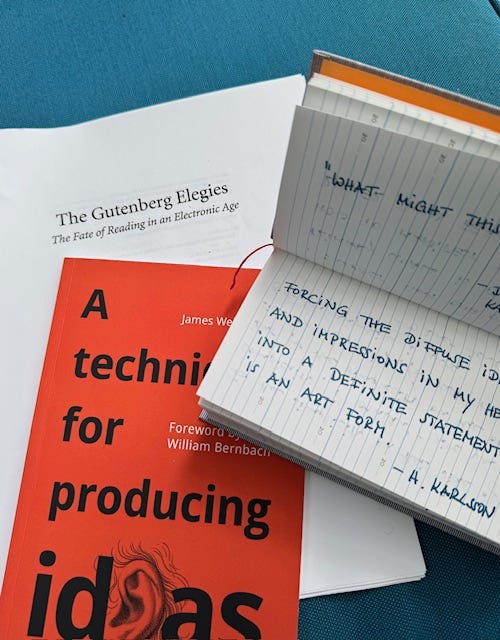
On the laptop in front of me, I type the word creativity into my Notion search field, and a quote I had written down in 2022 catches my attention. In the short book “A Technique for Producing Ideas,” James Webb Young, author and advertising agency executive in the 1920s through the 1950s, had written about the creative process:
“What you do is to take the different bits of material which you have gathered and feel them all over, as it were, with the tentacles of the mind. You take one fact, turn it this way and that, look at it in different lights, and feel for the meaning of it. You bring two facts together and see how they fit. What you are seeking now is the relationship, a synthesis where everything will come together in a neat combination, like a jig-saw puzzle.”
Click.
What a perfect description of what I had been trying to get at when I answered the question: ideas often don’t arrive at once and as a whole, but in parts or seemingly unrelated fragments. I can gather them patiently, combining curiosity and the expansiveness of drifting, looping, and trusting. Yes, the creative process is the turning over of puzzle pieces, becoming more familiar with their messages, texture and edges, to see which might fit.
The process necessarily starts with something I pay attention to – for me often concepts or feelings I am curious about. What particularly interests me is hard to describe. It’s more a radiating energy that draws my attention toward something that might hold an answer for me. It’s weird how that works, like some ring of truth. “Aha! Interesting, and this reminds me of something else, what was that again?”, I think, or “Why does this feel true to me?”
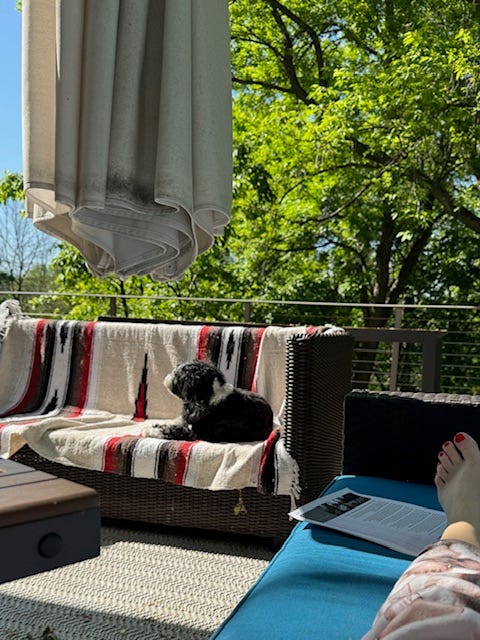
I grab two books, my journal and phone and walk out onto my deck. Stretching out under the golden early summer sun, I want to do some more searching and reading.
That click, it typically opens to something wider. Last week, I read David Bohm’s On Dialogue, and some of the author’s thoughts on communication and creativity are now mingling with a line by “my oracle” Henrik Karlsson that I’ve just come across on my phone screen, now getting hot from the sun:
“Forcing the diffuse ideas and impressions in my head into a definite statement is an art form.”
These subtle pulls of curiosity? They feel so fragile but vital, and it’s a way of honoring them when I follow them. And I find there also needs to be slack, some space I give myself for idleness. It’s often in this soft, unstructured state of energized tranquility that another puzzle piece finds its way to me.
In fact, it already had, also just the day before. I had read parts of The Gutenberg Elegies by Sven Birkerts. A paper-clipped excerpt of these essays had been sitting in one of my paper stacks for a few weeks. So finally I had picked it up, as if something inside me had nudged me. Already in 1994, writer and professor Birkerts was lamenting the decline of immersive reading and attention durability that he observed among his students. As antidote, he celebrated the human capacity for subjective interiority – this inner space where we can feel, think, and drift. He praised Virginia Woolf’s writing, a master in expressing “the motion” of thinking and creating. She had written:
“Thought is as much about the motion across the water as it is about the stepping stones that allow it… It is an intricate choreography of movement, transition, and repose, a revelation of the musculature of mind.”
Woolf put words to this being-state of creative and fluid searching; it’s like a current we can step into, if or when we are tapped in. Click. Isn’t she in a way also describing this day’s magic? My almost ecstatic feeling of flowing and moving, even if in a still hazy direction? A day when a few sparks of curiosity lead to an ongoing and serendipitous stream of interest or insight. I write both quotes down, and close my eyes, the moment fusing with some faint 80s music that is drifting over from a neighbor’s house.
The days of such fluid elation are my best days. I’m afraid to be greedy, as I want more and more of them, because I feel like living inside my curiosity. Over time, I have learned to lean into my own conditions that seem to favor this ineffable state that I treasure so much.
You know what else it feels like to me? Like an aesthetic experience. Ideas, layers of understanding – one fragment here, one reference there – come together like a mosaic borne by my taste. A piecing together of “somethings” into something new that hasn’t existed before, like this piece of writing.
From the outside, none of this feels very systematic. And yet. There’s a delicate inner order to it, with my attention as its scaffolding. I am noticing things and see if they speak to me and each other.
I’m a bricoleuse1, working with what’s at hand. Nothing flashy; just an ordinary person noticing what feels special in the ordinary.
It’s time to walk the dog.
Thank you to Rachel Parker, Rick Lewis, and Larry Urish for your helpful feedback and encouragement on this piece! Special thanks also to Harrison Moore who asked the original question that prompted this essay and gave me initial conceptual advice.
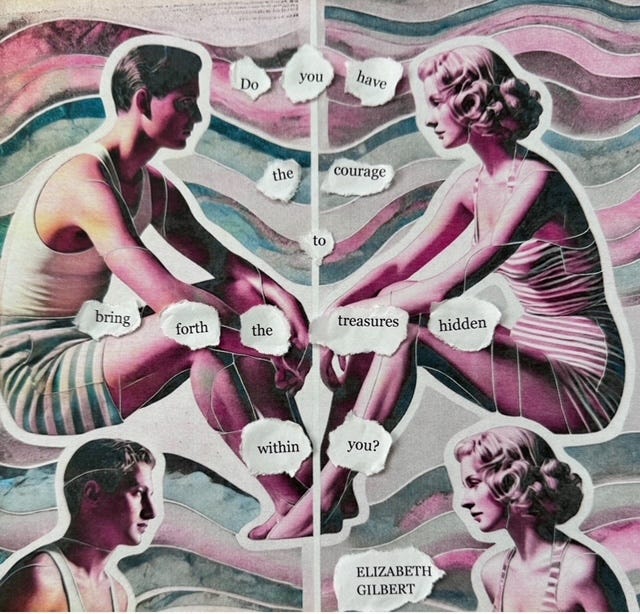
bricoleuse = the French word for tinkerer or creative assembler. I love both the word and the spirit of “bricolage”, the working with what’s at hand to make something new. This little collage, for instance, came together recently from an AI-generated image, a favorite quote, and some manual texturing.
“Lush morning sunlight welcomes me, letting my sisters, the leaves, dance with their shadows. I let the silence dilate for just a moment, and notice a question circling in my mind..”
What a perfectly dreamy and soft way to enter into an essay on the topic of our creative haze. I just love how this came together, Brigitte! A perfect description of a process that feels so difficult to nail down. Bravo!
…i wonder sometimes what would happen if i became a happy pillow…one that i or anyone could lay their head in…i share this because the delight you share and seek and share the seeking of reminds me of the spiritual equivalent of becoming a cloud…to which i wonder how much good is the goodest amount of good in a life…i am a see saw so many times…i say what i see saw…i love balanced unbalanced…but what if i was a pile of leaves…