

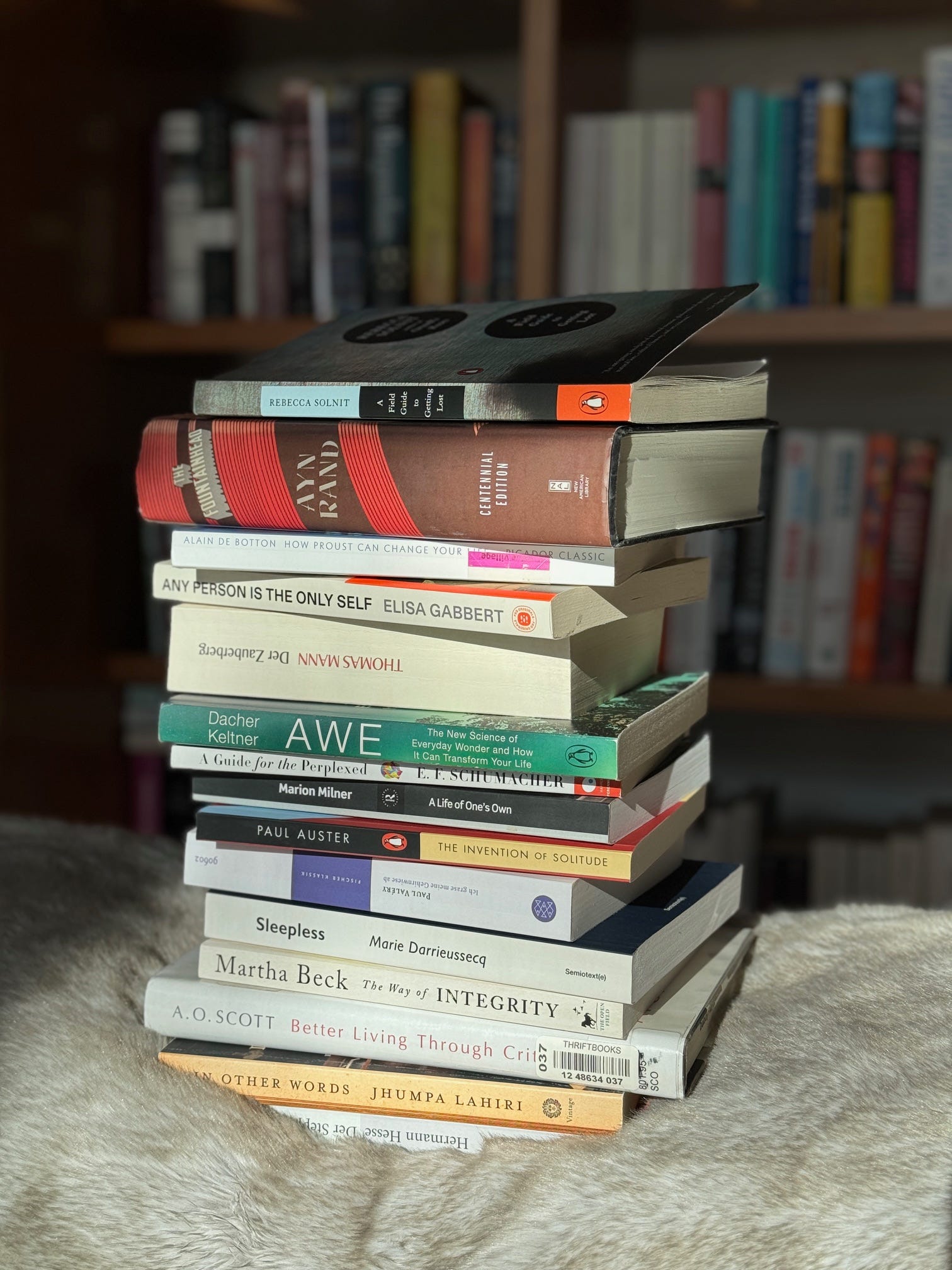
Sorry, I am adding to the avalanche of year-end reading reviews. But I believe this one is still worth your time.
I read dozens of fiction and non-fiction books every year and felt inspired1 to compile my list of the 20 of my most remarkable reading highlights in 2024—moments when words made me stop, gasp, and think about why I felt deeply touched by them.
The books I pull from for this article vary in genre, subject and tone. Yet, there seems to be a slender thread subtly uniting them: they illuminate insights about life’s fundamental truths that feel both timeless and personal, and worth sharing at the beginning of the year.
3, 2, 1, here goes:
Writing is the form of prayer that chose me. When I write, I drop so deeply into myself that I enter somewhere else, somewhere sacred and urgent, the silent place where Reality keeps what still needs to be said and seen and sung. When I come back, I craft a home for the unsaid thing, the living aurora that has curled up in my chest like a cat in sunlight. From words, I shape a place for it to live, a house of prose where people can visit, be touched by it, be transformed by the aurora’s bloom in the space behind their own hearts.
We’re Here to Renew the Sacred, by River Kenna (essays)
Why I love it: I’ve long been interested in how writers live, practice and describe their habits and feelings around their writing craft. River, writer and aliveness guide, expresses the mystery of writing with such poetic yet luminous clarity. I love his image of turning our personal, unspoken thoughts and ideas into a communal, tangible home that we can carry with us, revisit, and open up for others.
She liked to be alone; she liked to be herself.
To the Lighthouse, Virginia Woolf (novel)
Why I love it: In just a few words, Woolf captures the struggle between an instinct to support others and the selfishness that’s required for the desire of self-expression—especially for women in Victorian England and, to a lesser degree, today. In this book, she transforms her own inclination into something brave and beautiful—showing how being alone with oneself can be not just an escape, but an act of profound self-recognition.
I love you so much that nothing can matter to me- not even you…Only my love- not your answer. Not even your indifference.
Fountainhead, Ayn Rand (novel)
Why I love it: This isn’t just a love quote—it’s a radical declaration of love’s purest form, where the very act of loving transcends the need for reciprocation. Ayn Rand holds up the fierce independence of the feeling itself, despite the danger of such love devouring us. It’s about an ideal of love and its duality, between its potential that lives next to its built-in risk.
The art is not one of forgetting but letting go. And when everything else is gone, you can be rich in loss.
A Field Guide to Getting Lost, Rebecca Solnit (personal essays)
Why I love it: Going through some grief from transitions in life, in my case the gradual letting go that is involved from having a teenage daughter and elderly parents, I am interested in how to handle loss and uncertainty. Solnit’s reframing of loss as a form of richness spoke directly to my heart. Her distinction between forgetting and letting go opens us a space and way of thinking of these transitions not as something to get over, but as something that can deepen my capacity for life and love. Loss, in such re-evaluation, can become its own kind of permanent possession.
Having a willingness to feel good and have life go well all the time is a genuinely radical act.
The Big Leap, Gay Hendricks (non-fiction)
Why I love it: Gay Hendricks believes each of us has a kind of inner thermostat that determines how much love, success and creativity we allow ourselves to enjoy. He calls this individual conditioning—set in childhood—the ‘upper limit problem.’ This insight from human psychology is quite transformational and hopeful: We have the power for change and resetting these inner thermostats, even radically.
[I] was always trying to figure out how I, and other people, could create lives we actually enjoyed. … Integrity is the cure for unhappiness. Period.
The Way to Integrity, Martha Beck (non-fiction)
Why I love it: A perfect companion to the previous highlight, as Martha Beck lays out a way to compose the life we actually want and that feels right by pursuing the maxim of personal integrity. It takes no small amounts of discipline, but we can choose to do, in each moment, and even joyfully, what feels truest and most in line with our true nature, like a ‘bloodhound on a scent.’
Imperfection inspires invention, imagination, creativity. It stimulates. The more I feel imperfect, the more I feel alive.
In Other Words, Jhumpa Lahiri (memoir)
Why I love it: Lahiri wrote this book in Italian, a second language she only learned later in life. Writing in a second language myself, it was intriguing to read about her account of being humbled as well as enriched by language. There is so much metamorphic potential for a writer and speaker when engaging in and with another language. Her observation about imperfection leading to creativity particularly resonates with me—it’s precisely in the struggle with linguistic imperfection that I find new ways to express myself. The practice makes me paradoxically feel more alive, helping me discover new facets about myself and how I relate to the world.
And now we get to the hard part. The endings, the farewells, and the famous last words. If you don’t hear from me often, remember that you’re in my thoughts.
The Invention of Solitude, Paul Auster (memoir)
Why I love it: RIP Paul Auster. Oof, what a loss last year. I love tender authors and introspective writing. In this early book of this, Auster writes about the meaning and handling of memory that he calls the ‘space where things happen for the second time.’ What a beautiful sentiment, and I’d like to shout out the lines above to my friends and the meaningful people whose paths I’ve crossed in life: I think of you often, also when I’m absent, and you live in some corner of my heart’s mansion, even if we may now live in slightly different worlds.
You are going to feel like hell if you never write the stuff that is tugging on the sleeves in your heart…your truth, your version of things, in your voice.
Bird by Bird, Anne Lamott (non-fiction)
Why I love it: What better promise and warning about writing as expressed by Anne Lamott’s is there? Ignore that tugging in your heart at your own peril. Answer it and you might just find your voice.
Who would you be without your story.
Loving What Is, Byron Katie (non-fiction)
Why I love it: What a punch in the form of a mere 7 words. Ever feel stuck in ‘your ways’ of thinking and feeling, ever trying to actually get to a much clearer life? Then consider giving Byron Katie’s method a try. She calls it The Work—a process of introspection involving four questions to challenge and dissect stressful thoughts, culminating in a ‘turnaround’, a way to explore the opposite of a belief we carry. And this leads to direct experiences of this profound truth: ‘Reality is always kinder than the story we tell ourselves.’
There is no better way of coming to be aware of what one feels oneself than by trying to recreate in oneself what a master has felt. In this profound effort it is our thought itself that we bring into the light, together with his.
How Proust Can Change Your Life, Alain De Botton (non-fiction)
Why I love it: I haven’t read Marcel Proust’s work directly yet—certainly a future reading goal of mine. Even better when authors like De Botton act as intermediaries who create the indirect dialogue between the reader and a master’s original words (here Proust) and help reveal their intended meaning behind them. What Proust suggests in these lines is how reading isn’t just about passive consumption but also discovering ourselves. We can illuminate our own thoughts by trying to deeply understand another’s.
You know all your life that you’re going to die, but you don’t really know it, until you cross that fold. It feels like a crisis of faith, but faith in what? Not God, not in my case. Perhaps an unspoken belief I hadn’t realized I needed to function, an unexamined assumption that my life would continue getting better. That making good choices would lead to more freedom. I hadn’t known, really known, that there would be fewer choices.
Any Person Is The Only Self, Elisa Gabbert (essays)
Why I love it: I only discovered author Elisa Gabbert last year and love this collection of vulnerable, lively, and contagious essays she wrote about life, reading, literature, aging, and art. In these lines from ‘On Recently Returned Books,’ she articulates masterfully one of these precise instances we live through when abstract knowledge becomes visceral understanding—in this case our inevitable mortality.
The main question of my psychology. What persists through all states? What remains in sleep, in dreams, in drunkenness, in horror, in the rapture of love? in madness?
I Am Grazing My Brain’s Meadow, Paul Valéry (memoir, journals)
Why I love it: These lines are from the wonderful compilation from Paul Valéry’s (French poet, essayist, philosopher 1871-1945) personal—even secret—cahiers. He cuts right to the chase: what persists, what is our essence?
The human being is a multi-layered tissue, an onion consisting of many hundreds of layers, not a being with one layer or five, but innumerable: the human being is a woven fabric made of existing layers. Recognized and well known, this has been understood by the ancient Asians, and in Buddhist yoga a precise technique has been invented to peel off the delusion of personality.
Amusing and diverse is the game of humanity: the delusion of this leeration, which India has striven for so strenuously for thousands of years, is the same one that the Occident has so laboriously endeavored to support and strengthen.
Steppenwolf, Hermann Hesse (novel)
Why I love it: The delusion of identity and personality, masterfully described in three sentences. I like how the German author Hesse peels, with surgical precision, the human psyche like an onion in front of our eyes. He connects with seeming ease Eastern and Western philosophy through a single and startling metaphor. And what he reveals in the third sentence—how both East and West chase the same illusion, just from opposite directions reads almost like a cosmic joke, but explains so much.
The babies ‘slept through the night,’ while my nights were full of broken sleep. As my children learned to sleep, I unlearned. It’s hard to believe, but I had exchanged my sleep for that of my babies. And yet shouldn’t I have slept, since they slept?
Sleepless—A Memoir of Insomnia, Marie Darrieussecq (memoir)
Why I love it: My favorite memoir this year. Having suffered from longer and desperate bouts of insomnia myself, especially after the birth of my daughter (now a teen), I drank up Darrieussecq’s unabashed writing about the shocking nights, dead mornings, and her ‘creeping spider of malaise’ as a consequence of her sleeplessness. For those of you who have a weird nostalgia for sleep like me, this may be a book you want to read.
What is the structure of awe’s epiphany? Its big idea? What form of self-knowledge do we gain in experiences of awe? In our studies and the stories of awe we have encountered, people most reliably say something like: ‘I am part of something larger than myself.’
Awe, Dacher Keltner (non-fiction)
Why I love it: The topic of awe interests me, with its vicinity to the themes of intuition, meaning and connection. Dacher Keltner’s unique gift is his ability to examine awe through the scientific, personal, and spiritual lenses, showing how this profound emotion shrinks and expands us—making us feel small while connecting us to something greater.
Uninterrupted uniformity can shrink large spaces of time until the heart falters, terrified to death. When one day is like every other, then all days are like one, and (…) make the longest life seem very short, as if it had flown by in a twinkling.
The Magic Mountain, Thomas Mann (novel)
Why I love it: Mann performs magic in these lines and made me feel time itself shift on the page. In one breath, he captures both the terror of monotony and the way remarkable moments can crack time open. It’s also a reminder of why we read (to break the uniformity, to let nuance of colors and light in, and to break bread with the dead) and why we write (to make moments expand). The paradox of life—it can feel simultaneously endless and fleeting, depending on how we fill our days.
Complexity prods me to consider how I can participate in the world around me, rather than simply cower, with my head down. My gestures don’t have to be large, because all effects are local and one never knows what this butterfly flapping its wings will produce in the larger world.
Notes on Complexity, Neil Theise
Why I love it: Once in a while, I come across a book so surprisingly magical and profound that it fundamentally shapes my thoughts and understanding of the world (and universe)—and this (short, and non-fictional!) book fit exactly that bill in 2024. I have a crush on complexity theory with its explanatory power, and as an antidote to simplistic and rigid platitudes of organized religion. Dr. Theise wrote a beautifully clear and concise reconciliation of modern science and spiritual thought—plus who can’t love the thought that each moment in our lives has the random potential to surprise us with new possibilities.
Free yourself from the need for a top-down causation, for an explanatory principle for all that happens. Celebrate the simple beauty of the unexpected! The hard-earned credibility of science, the work of thousands of dedicated men and women around the globe over four centuries, should not be misused to seduce those who seek for a safe harbor. (…) The source of science’s true spirituality lies in revealing the material connectedness between us and the Universe.
The Simple Beauty of the Unexpected, Marcelo Gleiser (non-fiction)
Why I love it: Another great surprise discovery of author & physicist Gleiser who marries scientific rigor and spiritual wonder in this book. His imagery and vision of science as a path to both material and spiritual wisdom feel deeply authentic.
Let’s say that the critic is a person whose interest can help to activate the interest of others. That’s not a bad definition. (…) For that to work, what the critic writes or says has to be interesting in itself. And, of course, it can only really succeed in that way if the critic’s own interest is genuine. I may or may not like your drawing, but it’s essential that I care about it.
Better Living Through Criticism, A. O. Scott (non-fiction)
Why I love it: Renowned critic Scott unveils the secret of what makes writing about art, or any writing for that matter, magnetic. Critiquing is not about mere judgment but genuine care that sparks genuine interest (in this case in the reader). It reminds me that the best criticism, but also one’s own shared writings, aren’t about proving taste or intelligence. It’s about transmitting enthusiasm so purely that (some) others can’t help but catch it. This feels like permission and purpose wrapped in one. So give yourself permission to write about what you love and are enthusiastic about.
Particularly was I struck by the effect of writing things down. It was as if I were trying to catch something and the written word provided a net which for a moment entangled a shadowy form which was other than the meaning of the words. (…) Sometimes it seemed that the act of writing was fuel on glowing embers, making flames leap and throw light on the surrounding gloom, giving me fitful gleams of what before unguessed at.
A Life of One’s Own, Marion Milner (memoir, meta diary)
Why I love it: This hovering between two states—the verbalised and yet-to-be-captured—quite perfectly describes how writing often feels, and how difficult it actually is to catch fleeting thoughts. I wrote more about this state and feeling earlier this year in Going Where the Wild Things Are.
That’s a wrap—I wish us all many happy hours of reading in 2025!
Kolina Cicero and her post ‘The Most Beautiful Sentences I Read in 2024’ inspired me to follow a similar format for this annual reading recap. Thank you Kolina!
Brigitte! What an absolute honor to have inspired this list. Unbelievable. Thank you for sharing these gorgeous sentences!
Oh wow, fantastic practice. I...do not even highlight or take notes when I read, so I was thinking I'd be utterly incapable of producing a list like this.
What's your system? Inquiring minds need to know.
(Also—been wanting to read Mann. Proust is phenomenal. Read him!)