

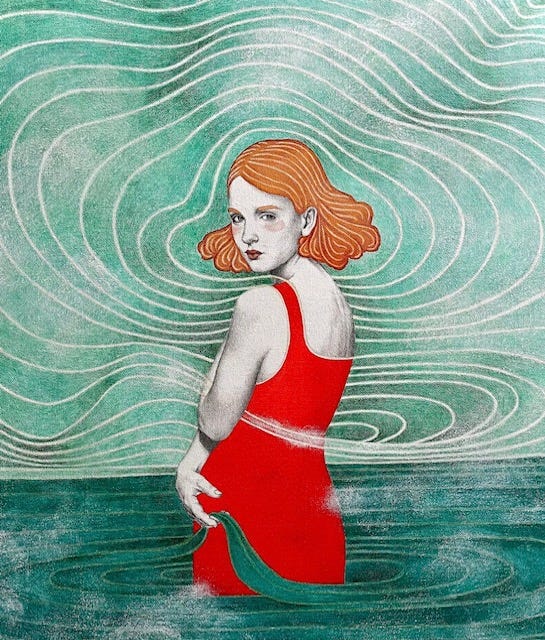
The tree which moves some to tears of joy is in the eyes of others only a green thing which stands in the way . . . As a man is, so he sees.
William Blake understood that we are what we perceive. What we see is based on the subjective experience and consciousness we inhabit, and the degree to which we are open or defended, present, or caught inside the haziness of recurring thought.
When we first come into this world, we naturally experience it with an open and curious heart. But over time, with the influence of lived experience and sociocultural imprinting, we form habituated ways of how we see and interpret the world around us. Each one of us creates a different version of reality, filtered through individual frames of reference, many of which were acquired in childhood and reinforced as we mature(d). My edge of the world and what I perceive as meaningful and possible differs from your edge of the world. Or, in the words of Scott Britton in his book Conscious Accomplishment: How to Use Personal Achievement for Spiritual Growth1:
What you believe to be true defines the boundaries of what’s possible in your life.
Virginia Woolf was very aware of how much of ordinary life was influenced by these habituated beliefs and routines. She referred to this as the cotton-wool of non-being, a dimmed state of consciousness that prevented her from being in more direct contact with reality and her deeper self. I suspect we are all latently familiar with this uncomfortable experience, or at least recognize something of ourselves in what poet Ezra Pound captured in these lines:
And the days are not full enough
And the nights are not full enough
And life slips like a field mouse
Not shaking the grass.
This cotton-wool effect is highly impactful devastating in the way it mediates our contact with the world. Once we reduced, unconsciously, our openness to the wonder that is present in our lived experience, even Blake’s striking example may become one’s subjective reality: a tree is merely seen as a green object standing in the way.
Sooner or later though, thankfully, most of us become more aware of this limiting condition. We realize that our consciousness can actually evolve and expand, through shifts in our perception, which then also moves the edge of what we see as vibrant, meaningful, and possible for us in the world.2
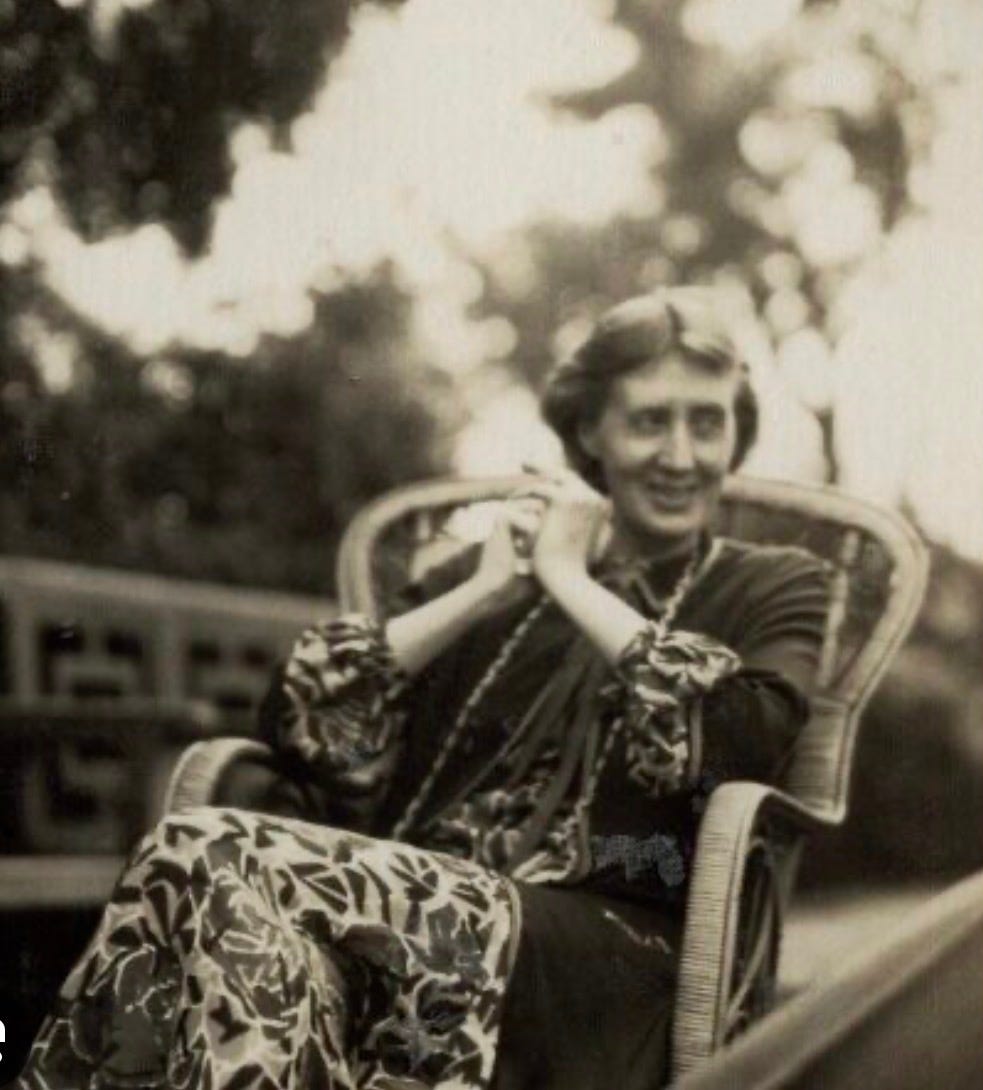
Virginia Woolf was quite in touch with this capacity for this deeper kind of awareness. A few times, she experienced inner states of such immense inner clarity and insight that she remembered them all her life, and eventually wrote about them too. In the essay A Sketch of the Past, part of a collection of autobiographical writings3 that were published posthumously, she described these vivid flashes in detail, when her heart got suddenly seized by something inescapable. In what she later called moments of being, the world suddenly appeared stunningly clear, alive, and connected, offering her glimpses of what lay behind the cotton wool. Here’s her description of one of these moments:
As a child [I passed] week after week at St Ives and nothing made any dint upon me. Then, for no reason that I know about, there was a violent sudden shock; something happened so violently that I have remembered it all my life… I was looking at the flower bed by the front door; “That is the whole,” I said. I was looking at a plant with a spread of leaves; the earth; that a ring enclosed what was the flower; and that was the real flower; part earth; part flower. It was a thought I put away as being likely to be very useful to me later.
Woolf’s moments of being, akin to an awakening into deeper levels of consciousness, can also cast William Blake’s tree metaphor in a fresh light. Depending on the consciousness we bring to it, even a tree can open our hearts and move us to tears, and be experienced from within a feeling of awe and oneness, and where the boundaries between ourselves and the tree begin to dissolve.4
Moments of being point to another big question about the reality of life. It was famously posed by Plato’s Meno over two thousand years ago, and it goes like this: How do we search for what we don’t already know?
Which I’d interpret to mean more specifically in the context of this essay: How do we find our way toward a more luminous and expansive reality and our own potential within it? Or do we already, at some deeper level, carry an intuition about “this way” and the direction of this search?
Scott Britton described this possibility beautifully in his book, written after years of deep spiritual work:
I believe that we have a higher self that keeps trying to align us with what we are meant to do.
Britton found that once he worked on understanding and unwinding his underlying reactive patterns and beliefs—a slower version of emerging from cotton-wool consciousness—he started to meet life more directly. Also, he started to notice and trust the mysterious ways reality seemed to even “conspire” to draw him forward along this path (yes, we see you, synchronicities!):
There are few greater gifts than being able to live at the edge of not knowing while being completely okay.
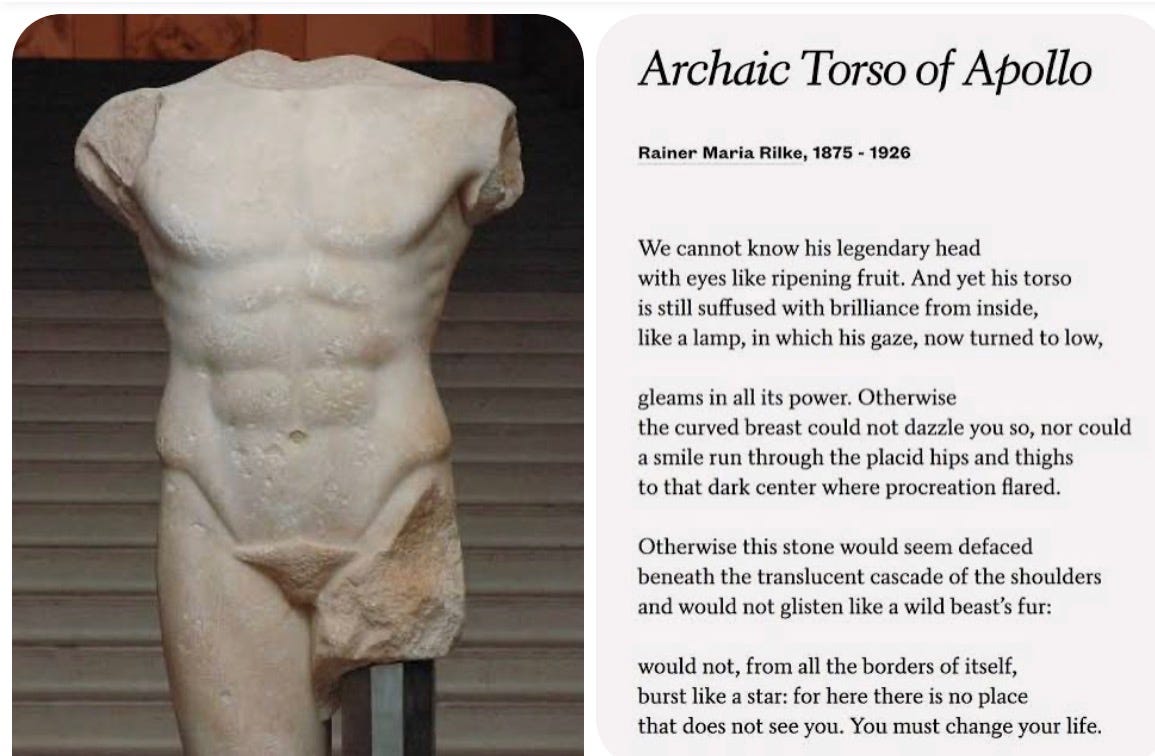
Also Rainer Maria Rilke had a distinct moment of being. In fact, he experienced it as a sudden shock into possibility. In 1902, during a period of close work with the sculptor Auguste Rodin in Paris, he frequently visited the Louvre. One day, standing before the ancient Apollo torso, a statue without eyes and face, he nevertheless suddenly felt utterly seen. Rilke sensed a piercing aliveness that was radiating from the stone, an experience he later memorialized in his famous poem Archaic Torso of Apollo, and the realization that
for here there is no place
that does not see you.
and this stunning final conclusion:
You must change your life.
In this notable moment in front of Apollo, the veil of Rilke’s ordinary perception and separation lifted, and he just knew right there and then: changing his life was possible, and up to him. And he did.
I think that these shocks, albeit less famous than Rilke’s, happen to all of us. Recently, I was part of a small group conversation under the guidance of Peter Merry5 about the skill of better listening, and a woman shared the story of a forest walk she did with a friend a few years ago. An owl had swooped down from a tree and violently grabbed her ponytail, a frightening experience that left her deeply shaken. With sudden clarity, she understood the owl encounter as symbolic and meaningful, forcing her to finally admit to herself a painful truth: I am unhappily married. That realization ultimately led her to leave her marriage and change her life (addendum: she and her ex-husband later remarried and found new harmony and happiness after a few years of work and healing).
We typically don’t reorganize our lives around a single revelation like the one in this example. More often, transformation happens more slowly and through gradual shifts in our ways of seeing this: we adjust our perception about the world and how we relate to our own potential.
I want to end this essay with Virginia Woolf’s conclusion about her moments of being:6
[I] reached what I might call a philosophy; at any rate it is a constant idea of mine; that behind the cotton wool is a hidden pattern. That we–I mean all human beings–are connected with this; that the whole world is a work of art; that we are parts of the work of art… we are the words; we are the music; we are the thing itself. And I see this when I have a shock.
We are the thing itself. You. I. All of us. When we start to see behind the cotton wool of our internalized limitations, we get vistas onto the astonishing landscape of our deeper self and our own vibrant potential and creativity.
This is our little art.
I want to thank Scott Britton for writing his inspiring book Conscious Accomplishment. My mind also goes back to the wonderful book discussion we were fortunate to have with him at the Leading Edge.
Thank you Rachel Parker for your support and editing help on this piece.
Britton, Scott. Conscious Accomplishment: How to Use Personal Achievement for Spiritual Growth. Spiral Works LLC, 2025.
A book that has been really formative for my thinking about the possible evolution of consciousness has been Tara Springett’s book The Stairway to Heaven: Nine Steps of Consciousness from Unawarenes to Full Enlightenment (2015), in which she lays out how it can move from fear, ego, and unconscious conditioning toward responsibility, compassion, inner freedom, and love.
Woolf, Virginia. Moments of Being: A Collection of Autobiographical Writing, ed. Jeanne Schulkind. Harcourt Brace Jovanovich, 1985.
I liked how James Bridle, author of the book Ways of Being—Animals, Plants, Machines: The Search for a Planetary Intelligence (2022) writes about the effect of looking at a tree, for example, as a subject instead of an object, and as one intelligence among the multitudes of other intelligences around us.
Peter Merry is the co-founder and Managing Director of Ubiquity University. I am currently part of a small cohort that applies, over the next 12 months, various practices for more presence and awareness in our daily lives.
Woolf, Virginia. Moments of Being.
"What you believe to be true defines the boundaries of what’s possible in your life." For me this says it all. Thank you Brigitte!
This essay is vibrating in unison with my experience of reality, and I find this deeply exciting.