

I. The start of the dance and setting of scene
I am counting on you to make my life meaningful, says no-one at the altar when entering marriage. What we also don’t confess to a new romantic partner is how we may be counting on them to please read our minds and fulfill the deficits in our lives.
But an egocentric approach to love is exactly what we often adopt, unconsciously, during the early glow of a new relationship. “Our egocentric culture revolves around the fantasy of the Magical Other, nourished through our pop music, mainstream cinema, advertising, ‘true romance’ novels, in prince and princess fantasies,” writes psychologist and wilderness guide Bill Plotkin in his book Soulcraft.1
I, for one, fell for exactly this fantasy when I was young (or even when not so young anymore). Maybe you have too. How wrapped up I was in the exhilarating dance of fresh young love – because what is more beautiful. No story seduced me more than the one in which someone else would hold and complete me. Two people moving as one.

We are in love! Can’t you see such exciting conditions? There is desire, union, fascination, and sexual ecstasy, all wrapped up in the overarching promise of wholeness, delivered by a special somebody, the Magical Other.
To a relationship, we bring so much hope, so much need, and – although typically first ignored – so much capacity for disappointment.
II. The dance’s enchantment and enmeshment
The new romantic dance intoxicates. We are drunk with enmeshment and the energy of being seen. We believe in the way the Other makes us shine, all destined to be. Hardly anything can stop us here, we may even, officially or not, swear that this love shall last until death do us part. Save me! Complete me! Make it right for me! are our new Eden’s battle cries. Unspoken. Our heavy agendas in disguise.
This innocence is, per se, not the problem though. Our still immature beliefs about what love is (or we need it to be) are rather normal, especially when we are young. No, the problem is, and again well expressed by Plotkin, the rarity of what should come next developmentally. More specifically, he advises:
…a more mature way of engaging a lover that has a deeper, more spiritual, sustainable, and yes, even sexier set of possibilities, an approach to romance that encourages and supports soulful development.2
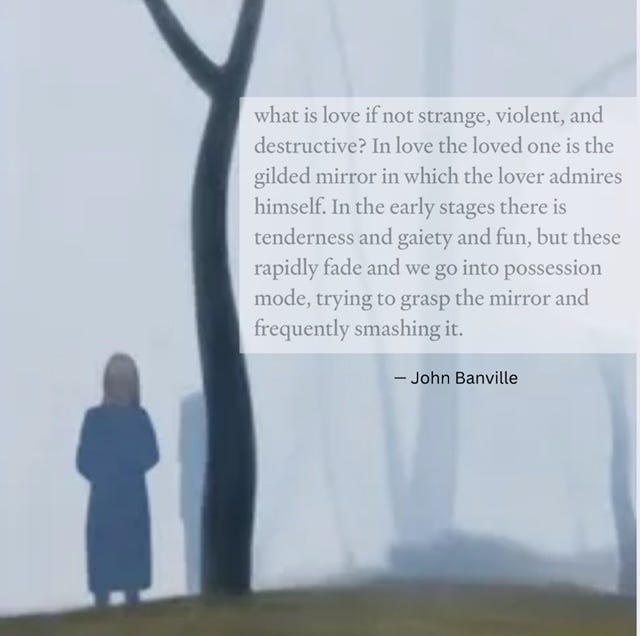
But before we ever reach this more evolved way of loving, we may first pass through far more turbulent terrain. What seeps into the dance, at this stage, is a reality of possession. The veil of perfection begins to lift, and what we suddenly start to see are obstacles and dramatic stakes our ego cannot bear.
And so we revolt. We destroy. We smash the mirrors.
The root of the problem at this stage of the dance is that two lovers get wrapped up too tightly with each other and within themselves. They have not gained the necessary distance and space in which they could recognize how their anger and sadness, now turned into weapons against the Other, tell the story of their own projections.
Sadly missed completely is how what they project is in reality what they’ve rejected and stunted in themselves.
III. The dance’s escalation into rupture and internal rift
The fantasy of the Magical Other does not want to die easily. Stopping the music now seems unimaginable. But there is a fundamental truth so hard to bear: romance can never be any better than our relationship with ourselves.
Instead, we are caught in misunderstandings and our own sensibilities – no small opponent. When Goethe published The Sorrows of Young Werther two and a half centuries ago, he created the epitome of a tragic figure in the young man Werther. Werther finds himself hopelessly in love with Charlotte, a woman engaged (and later married) to another man. He feels trapped in what must be the “error of the other.” Writes Goethe:3
Good sensible people often withdraw from one another because of secret differences, each becoming absorbed by what he feels is right and by the error of the other. Conditions then grow more and more complicated and exasperating, until it becomes impossible to undo the knot at the crucial moment on which everything depends.
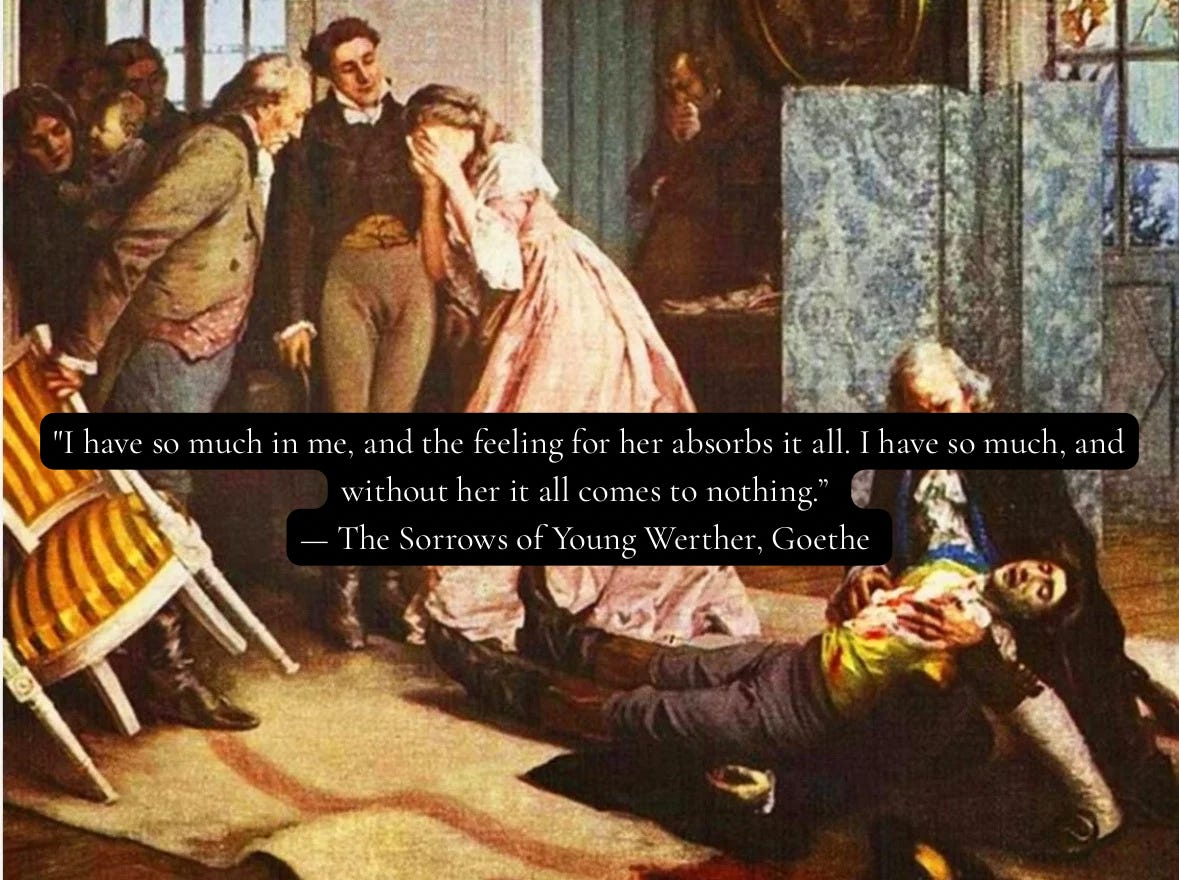
Werther’s torment of internal chaos, and contemporary culture in 18th century Romanticism even found the term Werther’s fever for it, leads him to the most dramatic outcome: he takes his own life over his sorrows. Delving into such extreme human emotion and internality in a character was still new at that time, and readers couldn’t get enough. After the book’s publication, Goethe’s star rose quickly. Unfortunately, and unintended by Goethe, a frenzied trend was sparked too: A number of young men committed suicide out of despair over their impossible love for a married woman; some even died with the book in hand.
Fortunately, such tragic worst case of desperate love is rare. My essay wants to make a larger point. Without new-found perspective and inner work, too often a relationship ends in rupture and bitterness. There is no easy salvation.
Here, the disillusionment is complete. The lovers either leave the dance or start to see what love may have been trying to teach them all along.
IV. After disillusionment: we finally enjoy the dance for the dance, either with a partner or alone
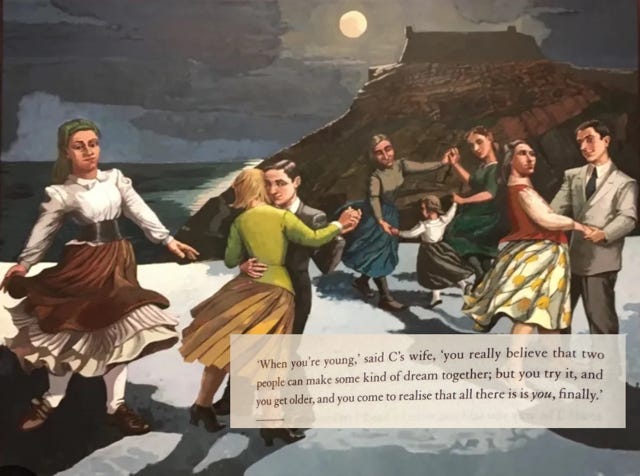
When you’re young,” said C’s wife, “you really believe that two people can make some type of dream together; but you try it, and you get older, and all you come to realise that all there is is you, finally.4
Australian writer Helen Garner wrote down these sparse lines in her personal diaries. A casual, passing comment surely, but important enough for her to take note.
Consider the mature insight: The very thing we wanted to find in the Other for fulfillment can only be found in ourselves.
Once we dare to look in the mirror and start enjoying the dance for its own sake, we finally realize that growing up is up to us. There is no Magical Other who can make us feel whole for us.
Real, realistic love is only possible between two whole people, two individuals who have faced their own loneliness first, and can meet each other freely and without a selfish urge to escape what is our existential fear. The first belonging must be to ourselves. Without such inner rooting, every relationship becomes an attempt to be saved rather than to flourish and support each other’s growth. This new distance and new perspective are needed to protect love from collapsing into need.
“Love is possible only if two persons communicate with each other from the center of their existence,” wrote Erich Fromm in The Art of Loving5. When we turn away from ego and toward our soulful center, what we find has always been there. The hopes of when we were children. The bright joys of living. All our untapped talent.
V. Where the dream dies, a new dance may begin

When the old ego dreams die, a new kind of dance can begin, amid the grace of a second spring. Finally, we are ready for the Real Other, in exchange and conversation with the real me. Already Rumi tried to teach us that the mysterious secret about love is seeing the beauty of our own soul through the eyes of somebody else:
The minute I heard my first love story
I started looking for you, not knowing
how blind I was.
Lovers don’t finally meet somewhere.
They’re in each other all along.
This kind of soulful romance rests on what James Hollis, psychologist and Jungian scholar, referred to as a radical conversation, in which two partners want their relationship to serve their individuation and growth rather than their limiting projections:
“Not you plus me, but we who are more than ourselves with each other.”6
By releasing the fantasy of the Magical Other, we make room for the real wonder in romance that is built on the imagination described so well by Tamara in her essay The Imagination of the Other:
Imagining the Other takes work. It demands patience, and worse, humility… the willingness to be wrong, to guess clumsily, to keep revising the image you’ve built… To love not the fixed portrait but the shimmering apparition that shifts every time you look again.
The fantastical dance is over, replaced by what is so much more satisfyingly real and liberating. We find what our soul has wanted us to see all along, namely our own emotional blockages, blind spots, wounds, and limitations.
This is the dance of our lifetime. Realizing our own wholeness and unlived potential, in loving exchange and in relation with another.
But we have to do the work.
In gratitude to my writing friends Rachel Parker Michelle Elisabeth Varghese Rick Lewis Larry Urish Linda Kaun for their precious support and editing help.
Bill Plotkin, Soulcraft: Crossing into the Mysteries of Nature and Psyche, New World Library (Novato, 2003), p. 282
Ibid., p. 283
Johann Wolfgang von Goethe, The Sorrows of Young Werther, trans. Burton Pike (New York: Modern Library, 2004)
Helen Garner, How to End a Story: Collected Diaries (London: Weidenfeld and Nicolson, 2025), p. 26
Erich Fromm, The Art of Loving (New York: Harper & Row, 1956), p. 95
James Hollis, The Middle Passage: From Misery to Meaning in Midlife (Toronto: Inner City Books, 1993), p. 61
Brigitte, I really loved this. It’s such an honest and generous look at the difference between immature and mature love, and you write it with so much clarity and compassion. The way you describe the early fantasy of the Magical Other, and then gently walk the reader toward something truer and more grounded, is beautifully done. And as always, your eye for art and quotes is impeccable, they don’t just accompany your words, they feel woven into the thinking itself.
This feels like the real interior hero's journey in 5 acts, and a hopeful ending!